

How to Integrate Big Data Strategy With Your Supply Chain to Predict Geopolitical Risks
In an era where a single policy shift, a maritime blockage, or a localized conflict can paralyze global commerce, your supply chain resilience is no longer merely an operational detail: it is a strategic imperative. The traditional models of supply chain management, built on the foundations of "just-in-time" efficiency and lean cost-cutting, are increasingly insufficient in the face of today’s volatile geopolitical landscape.
For the modern executive, the challenge is daunting: how do you steer a global enterprise through the fog of trade wars, shifting sanctions, and regional instabilities without compromising growth? The answer lies in the meticulous integration of Big Data Strategy with supply chain operations. At MOHBILITY, we believe that data is not just an asset; it is the predictive engine that transforms uncertainty into a manageable variable.
The Fragility of Efficiency: Why Traditional Models Fail
For decades, the global supply chain was optimized for stability. However, the "new normal" is defined by disruption. Whether it is the sudden imposition of tariffs or the closure of critical shipping lanes, the ripple effects are felt instantly across your entire network. Relying on historical data or reactive crisis management is a high-stakes gamble that few can afford to lose.
The problem is that most organizations operate with fragmented data silos. Your logistics team might see port congestion, while your procurement team tracks supplier delays, but neither has a comprehensive view of the underlying geopolitical catalysts. This lack of synergy creates a blind spot that leaves you vulnerable. To move forward, you must transition from a reactive posture to one of predictive adaptability.
The Synergy of Big Data and Geopolitical Mitigation
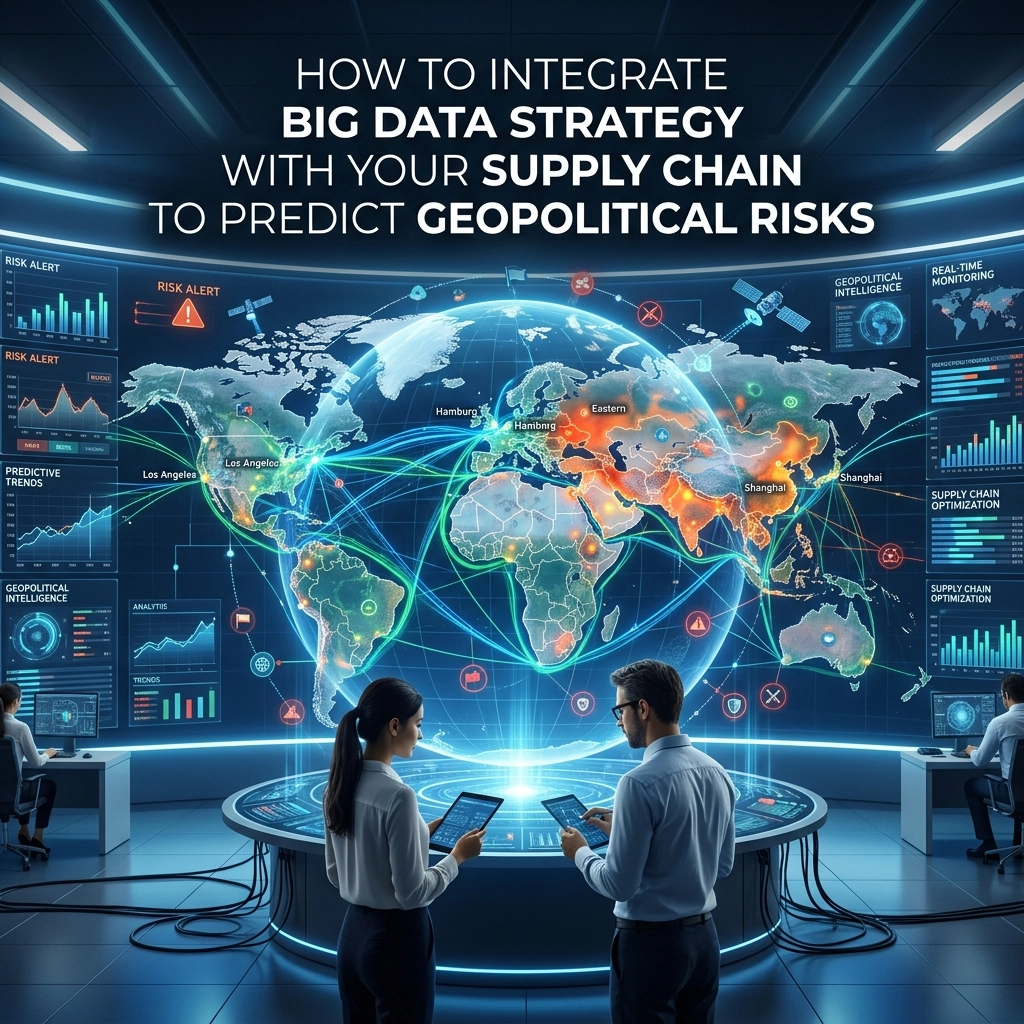
Integrating Big Data Analytics (BDA) into your supply chain allows you to move beyond basic visibility. It enables you to simulate the future. By converging vast streams of structured and unstructured data, you can create a digital twin of your global operations that responds in real-time to external pressures.
This integration is built on three core pillars:
- Real-Time Decision-Making: Moving from monthly reviews to minute-by-minute adjustments.
- Predictive Analytics: Identifying the "weak signals" of political unrest or economic shifts before they escalate.
- Scenario Modeling: Testing your supply chain against "what-if" geopolitical events to ensure you have a robust contingency plan in place.

Mapping Your Geopolitical Risk Exposure
Before you can deploy a Big Data Strategy, you must understand exactly where your vulnerabilities lie. Geopolitical risk is not a monolith; it manifests in several distinct ways that require tailored mitigation strategies.
- Resource Access Disruptions: This involves the sudden inability to source raw materials due to export bans, environmental regulations, or political instability in the source country.
- Technological Isolation: In an age of "tech nationalism," your access to critical software, semiconductors, or specialized hardware can be cut off by shifting trade policies or sanctions.
- Transportation Vulnerabilities: From the Red Sea to the South China Sea, maritime and land-based corridors are subject to physical blockades or exorbitant insurance hikes during periods of tension.
By utilizing Business Performance Analysis, you can map these risks to specific nodes in your supply chain, identifying which components, suppliers, or routes are most critical to your continuity.
Building the Architecture of Intelligence
A sophisticated Big Data strategy requires a robust data architecture. It is not enough to simply collect data; you must curate the right data. To predict geopolitical risks effectively, your supply chain model should ingest feeds from a diverse array of sources:
- Country Risk Indicators: Real-time monitoring of political stability scores, credit behavior, and ESG (Environmental, Social, and Governance) data.
- Logistics and Infrastructure Data: Port throughput, customs declarations, vessel movements, and lane capacity metrics.
- Geopolitical Intelligence: Social media sentiment analysis, news alerts regarding labor strikes, and legislative tracking for new trade policies.
- Internal Operational Data: Inventory levels, supplier lead times, and financial hedging positions.
When these datasets are integrated into a unified dashboard, your leadership gains a "single source of truth." This level of transparency allows you to anticipate disruptions, giving you the lead time necessary to reroute loads or shift sourcing before your competitors even realize there is a problem.

Three Pillars of Implementation: Predict, Adapt, Collaborate
At MOHBILITY, our Agile Implementation Consulting focuses on turning these data insights into decisive action. The implementation of a data-driven geopolitical risk strategy follows three coordinated steps:
1. Predict
The goal is to move from "What happened?" to "What will happen?" Use machine learning algorithms to analyze historical patterns of disruption alongside current events. For instance, an automaker might use BDA to predict that rising tensions in a specific region will likely lead to a 20% increase in freight costs over the next quarter, allowing the finance team to adjust their Commodity Trade and Investment strategies accordingly.
2. Adapt
Intelligence is useless without the capacity to act. Predictive adaptability means having pre-vetted alternative suppliers and pre-mapped logistics routes already integrated into your system. Instead of searching for a new supplier in the middle of a crisis, your data strategy should have already identified three "warm" alternatives in politically stable regions. This diversification is key to maintaining a Project Facilitation timeline that remains uncompromised.
3. Collaborate
Geopolitical risk mitigation is a team sport. Organizations that share risk data with their Tier-1 and Tier-2 suppliers report a 63% reduction in crisis recovery time. By creating a collaborative data ecosystem, you empower your entire network to respond in unison. This level of transparency builds trust and ensures that every partner in your chain is operating with the same high standards of integrity and accountability.
Scenario Modeling: The Ultimate Competitive Advantage
One of the most powerful applications of Big Data in the supply chain is scenario-based planning. Using AI-driven models, you can simulate a wide range of geopolitical "black swan" events: from a sudden conflict in Eastern Europe to a major trade embargo.

These simulations provide a "stress test" for your operations. They answer critical questions: How long could we survive if this port closed? What is the financial impact of a 15% tariff on this specific component? Which of our partners has the highest exposure to this specific regulatory change?
By meticulously analyzing these scenarios, you can develop tailored solutions that maximize resilience while minimizing unnecessary costs. You no longer have to rely on expensive "just-in-case" inventory stockpiling. Instead, you rely on the precision of your data to guide your investment.
Transitioning to a Data-Driven Future
The integration of Big Data Strategy into your supply chain is not a one-time project; it is a fundamental shift in how you view global operations. It requires a move away from "business as usual" toward a culture of continuous Insights and rapid iteration.
As a trusted partner in management consulting, MOHBILITY is dedicated to helping you navigate this transition. We understand that the global regulatory landscape is complex and that the stakes for your international investments have never been higher. Our mission is to provide you with the tools and expertise to not only withstand global volatility but to use it as a springboard for growth.
By embracing a sophisticated, data-centric approach, you unlock a level of operational excellence that transcends traditional boundaries. You gain the peace of mind that comes from knowing your organization is prepared for whatever the global stage may present.
Take the Next Step Toward Resilience
The path to a resilient, data-driven supply chain begins with a comprehensive audit of your current capabilities and a clear-eyed assessment of your geopolitical exposure. Don't wait for the next global crisis to expose the gaps in your strategy.
Whether you are looking to optimize your Real Estate Investment portfolio against regional shifts or require Merger and Acquisition Facilitation to diversify your manufacturing footprint, the time to act is now.

Ready to transform your global strategy? Contact us today or book a consultation to discuss how we can help you integrate Big Data into your supply chain and secure your competitive advantage in an unpredictable world. At MOHBILITY, we don't just solve problems; we empower you to steer the future.