

7 Mistakes You’re Making with Big Data Strategy (and How to Fix Them)
If you lead a boutique professional services firm: whether in law, accounting, marketing, insurance, or real estate: you are likely sitting on a goldmine of operational data. Every client engagement, billing hour, market transaction, and support ticket generates a continuous stream of valuable information. Yet, many owner-led firms struggle to translate this chaotic influx of information into actionable competitive advantage.
In today's fast-paced environment, relying on intuition alone is no longer sufficient. To scale sustainably, protect margins, and outperform larger competitors, you need a meticulous big data strategy paired with disciplined business process optimization. Unfortunately, many organizations stumble into preventable traps that drain capital, frustrate teams, and stall growth.
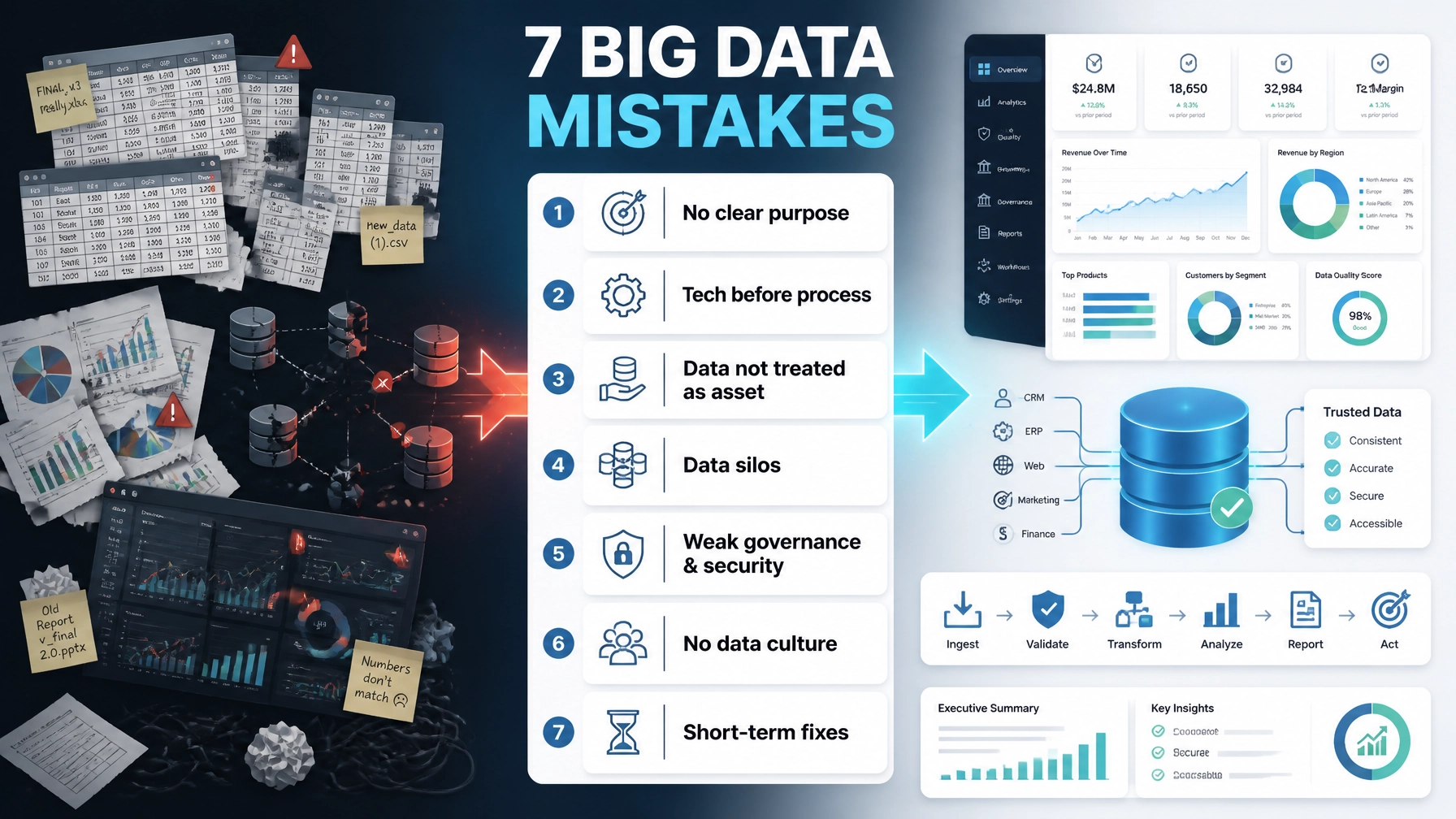
Here are the top seven mistakes businesses make with their data strategy: and how you can fix them to unlock enduring value.
1. Launching Without a Clear Business Purpose
The most frequent misstep is embarking on data collection and analytics initiatives without defining the precise business problems you intend to solve. Many firms plunge into big data projects driven by the sheer availability of information, failing to tie analytics to core strategic objectives.
- The Symptom: You invest in impressive, expensive dashboards that display endless metrics but fail to shift operational margins, client retention rates, or cycle times.
- The Impact: Data initiatives morph into academic exercises rather than rigorous levers for growth and efficiency.
- The Fix: Ground every analytical initiative in specific, measurable business goals. Before writing a single query or investing in a new platform, establish targeted questions: Which client segments generate our highest profitability? Where are the bottlenecks in our onboarding workflow? Align your metrics directly with your bottom-line priorities.
2. Letting Technology Lead Instead of Process Needs
It is easy to fall prey to "shiny object syndrome." Countless firms allow software vendors and buzzwords: such as advanced AI, data lakes, or complex cloud architectures: to dictate their roadmap rather than starting with fundamental workflow requirements.

- The Symptom: Adopting enterprise-grade platforms that your team lacks the capacity to utilize, resulting in low adoption rates and negligible impact on daily operations.
- The Impact: Professionals view data tools as cumbersome IT burdens rather than intuitive enablers of better client service and decision-making.
- The Fix: Prioritize business process optimization over platform procurement. Map out your core operational workflows first, identify friction points, and select technology strictly on its ability to streamline those specific tasks.
3. Treating Data as Operational Exhaust Rather Than a Strategic Asset
Many organizations view data merely as a byproduct of daily transactions: documents filed, emails sent, invoices paid: rather than treating information as a core corporate asset that requires proactive management and monetization.
- The Symptom: Historical records are archived in disparate folders, emails, and legacy software, never to be reviewed, audited, or cross-referenced.
- The Impact: Missed opportunities to uncover cross-selling trends, optimize pricing models, or anticipate client churn before it happens.
- The Fix: Explicitly map your data assets to value streams. Treat your proprietary data with the same financial rigor and accountability as cash in the bank. Conduct regular audits to identify how historical insights can inform future service offerings and strategic positioning.
4. Maintaining Fractured Data Silos
In many owner-led professional firms, departments operate on isolated islands. Marketing uses one platform, billing uses another, and client management lives in spreadsheets or legacy databases.
- The Symptom: Inability to obtain a unified, 360-degree view of a client relationship across the entire firm lifecycle.
- The Impact: Fragmented insights lead to contradictory decisions, duplicated administrative effort, and a disjointed experience for high-value clients.
- The Fix: Break down departmental barriers by designing centralized data architectures around end-to-end client journeys. Integrate critical systems: such as your CRM, billing software, and operational logs: into a cohesive, secure environment where a single version of the truth prevails.
5. Overlooking Data Governance, Quality, and Security
When data is collected haphazardly without central oversight, quality inevitably degrades. Incomplete client records, duplicate entries, and inconsistent categorization undermine the reliability of any downstream analysis.

- The Symptom: Decisions are delayed because leadership does not trust the numbers, or worse, strategic moves are made based on flawed reports.
- The Impact: Heightened regulatory and privacy compliance risks, alongside vulnerability to data breaches and compromised client confidentiality.
- The Fix: Institute robust data governance frameworks. Define clear ownership for every critical data domain (client records, financial ledgers, project metrics), establish strict quality validation rules, and embed stringent privacy and cybersecurity protocols from day one. Integrity, transparency, and accountability must form the bedrock of your data handling practices.
6. Neglecting People, Skills, and Data Culture
Even the most sophisticated data infrastructure will fail if your team lacks the literacy and confidence to interpret insights and act upon them.
- The Symptom: Advanced predictive models sit idle while staff continue making critical decisions based strictly on gut feeling or historical habit.
- The Impact: Resistance to change, low return on technology investments, and a widening internal skills gap.
- The Fix: Approach your strategy through the lens of organizational change management. Invest in continuous data literacy training for your professionals, ensuring that everyone from senior partners to associates can read, question, and apply data effectively within their daily workflows.
7. Relying on Short-Term, Non-Scalable Initiatives
Many firms chase quick fixes: implementing isolated proofs of concept or hiring freelancers for one-off data cleanups: without designing a scalable, long-term roadmap.
- The Symptom: A graveyard of disconnected pilot projects that never transition into core operational systems.
- The Impact: Wasted capital, repeated mistakes, and an inability to scale operations as your client base expands across international or domestic markets.
- The Framework: Shift away from fragmented, one-size-fits-all experiments. Partner with experienced advisors to build a phased, tailored roadmap that balances immediate high-impact wins with long-term technological resilience.
The Path Forward: Tailored Digital Transformation Consulting
Navigating the complexities of modern data architecture and digital transformation consulting can feel overwhelming, particularly when you are managing day-to-day client obligations. You do not need another generic software pitch or a superficial tutorial; you need a seasoned, trusted partner who understands the unique operational dynamics of professional services firms.

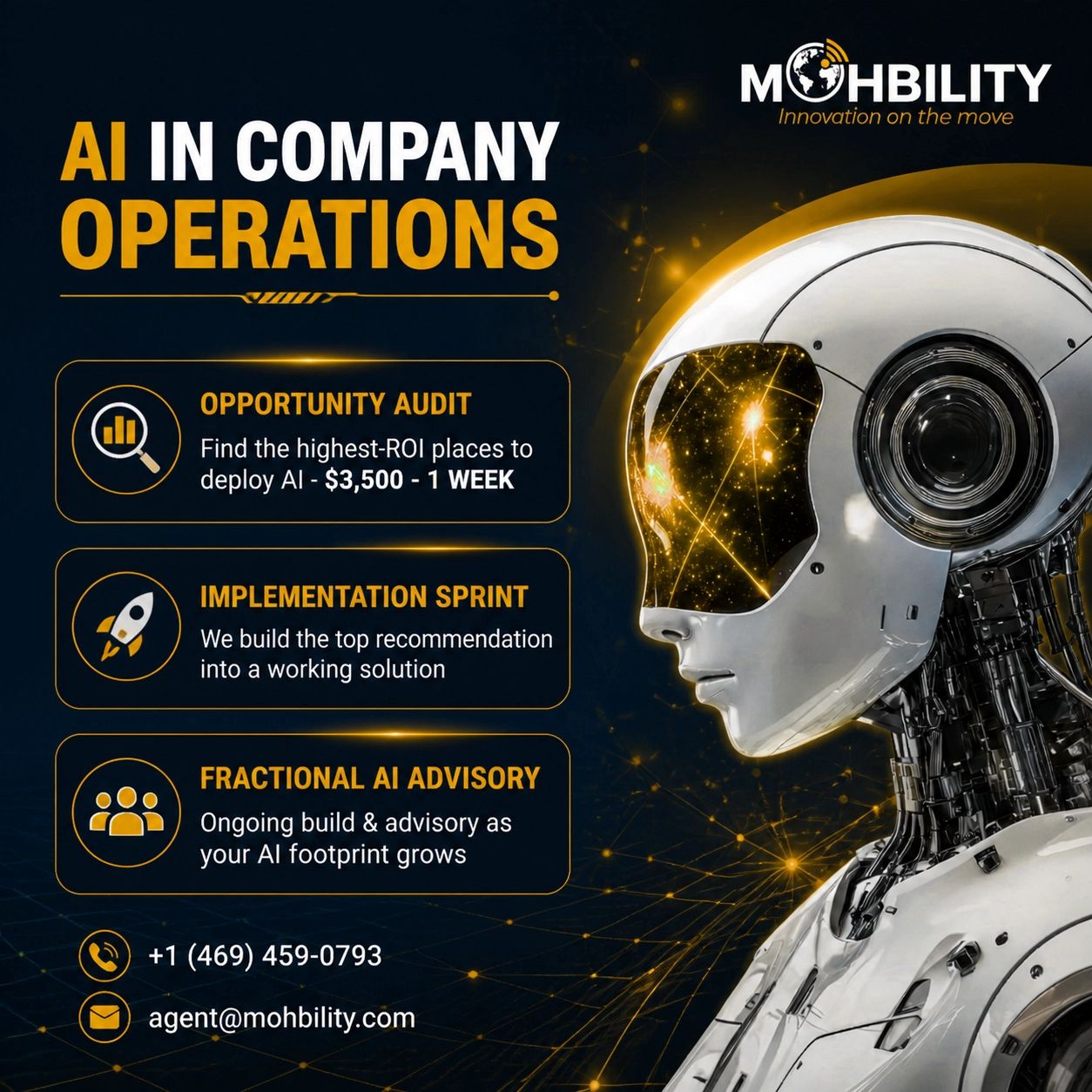
At MOHBILITY, we specialize in helping businesses optimize their operations, strategies, and performance globally through meticulous analysis and innovative technology adoption. We reject one-size-fits-all software packages in favor of customized solutions designed to maximize returns while aggressively minimizing risks.
Take the First Step: The AI Opportunity Audit
Stop guessing where your data strategy falls short. Gain absolute clarity with our AI Opportunity Audit: a comprehensive, $3,500, 7-day diagnostic designed specifically for ambitious firms ready to unlock their operational potential.
- Rapid Assessment: A thorough 7-day evaluation of your current data assets, workflows, and technology stack.
- Actionable Insights: Clear identification of hidden process bottlenecks, data silos, and immediate monetization opportunities.
- Tailored Roadmap: A customized, high-impact action plan to streamline operations, enhance client experiences, and secure your competitive edge.

Empower your firm for future-proof success. Do not let unstructured data compromise your growth.
Schedule your AI Opportunity Audit today. Unlock your data's true potential and steer your business toward global excellence, innovation, and sustainable profitability.