

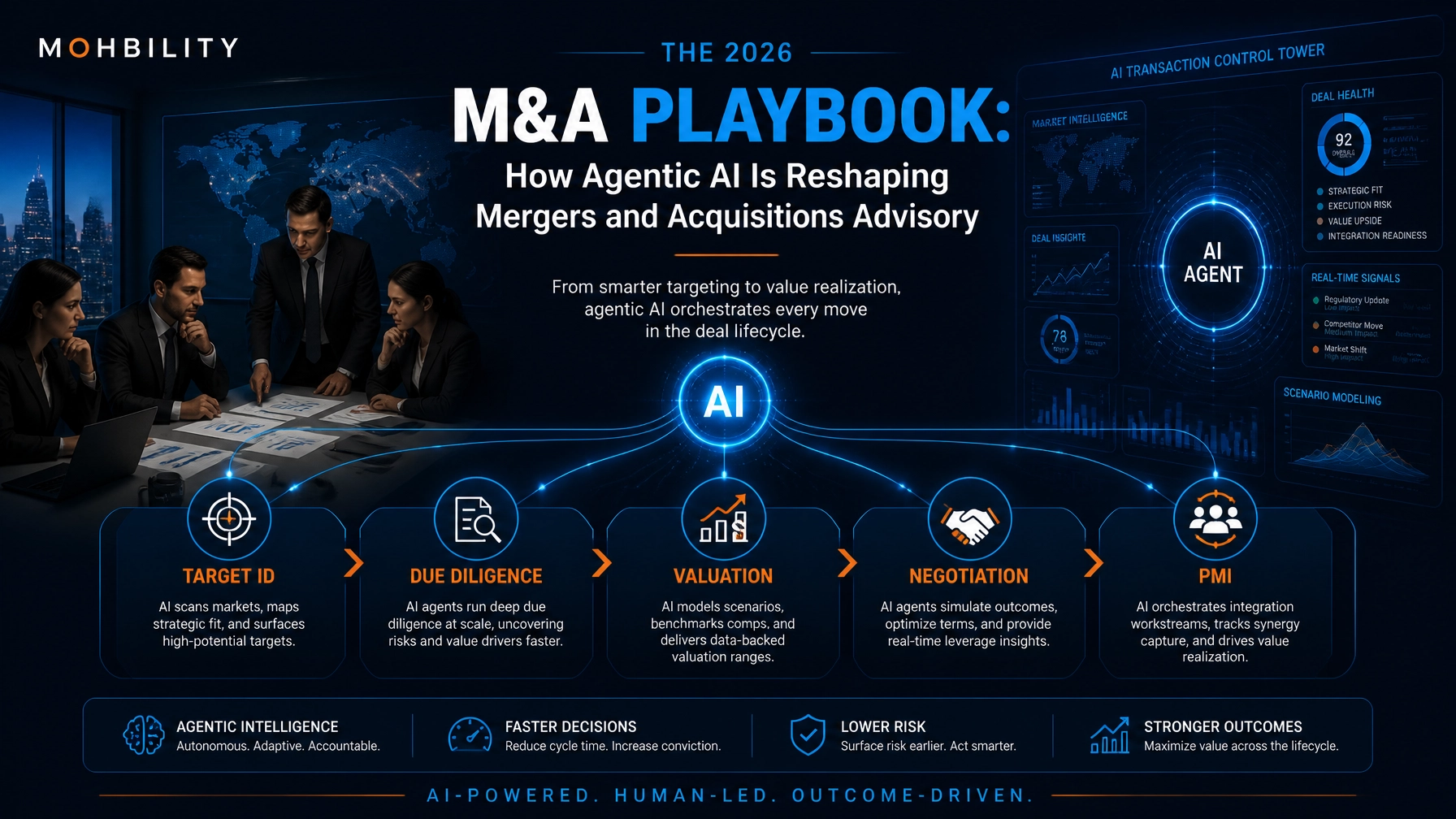
The 2026 M&A Playbook: How Agentic AI Is Reshaping Mergers and Acquisitions Advisory
Mergers and acquisitions are entering a new operating era.
The challenge is not simply that transactions are becoming more complex. Deal teams must now evaluate vast volumes of structured and unstructured data, assess technology and cybersecurity risk, navigate cross-border regulation, and determine whether a target’s artificial intelligence capabilities create durable value: or temporary market excitement.
Traditional processes remain essential. However, they are no longer sufficient on their own.
Agentic AI is changing how deal teams identify opportunities, conduct due diligence, model valuation, negotiate terms, and capture synergies after closing. Unlike basic automation, agentic AI can interpret objectives, coordinate multi-step workflows, use approved enterprise systems, and return findings for human review.
That creates a powerful opportunity. It also introduces new responsibilities around governance, transparency, and accountability.
For senior executives, the question is no longer whether AI belongs in the M&A process. The more important question is whether your M&A advisory partner can help you apply it intelligently.
Why the M&A Playbook Must Change
The traditional M&A lifecycle often depends on fragmented databases, manual document review, disconnected spreadsheets, and sequential handoffs among legal, financial, operational, and technology teams.
That approach can create serious limitations:
- Valuable targets may be overlooked because screening is too narrow.
- Critical contract, data, or technology risks may remain buried in unstructured documents.
- Valuation assumptions may fail to reflect AI-related costs and dependencies.
- Negotiation teams may lack a complete view of leverage and downside exposure.
- Post-merger integration may begin without a clear technology or value-capture roadmap.
Agentic AI helps address these issues by connecting information, workflows, and decision points across the transaction lifecycle. It does not replace experienced executives, investment committees, or specialist advisors. Instead, it gives them faster access to better-organized evidence.
That distinction matters. In high-stakes transactions, human judgment remains essential. AI should accelerate analysis: not eliminate accountability.
1. Target Identification: From Broad Screening to Strategic Fit
Target identification has traditionally relied on sector databases, referral networks, investment bankers, and internal market knowledge. These channels remain valuable, but they can be slow and difficult to scale across global markets.
Agentic AI allows your team to create a more dynamic sourcing process.
An AI-enabled system can:
- Screen companies against strategic, financial, and geographic criteria.
- Identify emerging competitors and adjacent-market opportunities.
- Monitor changes in funding, hiring, partnerships, patents, and customer activity.
- Compare targets against your acquisition thesis.
- Enrich target profiles using approved internal and external data.
- Rank opportunities according to strategic fit, risk, and integration potential.
The result is not merely a longer target list. It is a more intelligent pipeline.
Your advisory partner should help you define the investment thesis before deploying technology. For example:
- Are you seeking proprietary data?
- A new regional distribution network?
- Complementary intellectual property?
- A vertical AI capability?
- Cost synergies or revenue expansion?
- An acquisition that can strengthen your digital infrastructure?
Agentic AI is most valuable when it is directed by a clear strategic purpose. Otherwise, it can produce large volumes of information without improving decision quality.
2. Due Diligence: Broader Coverage, Faster Risk Escalation
Due diligence is one of the clearest areas where agentic AI can transform M&A advisory.
A modern AI diligence workflow can review contracts, financial records, vendor agreements, intellectual property documents, regulatory materials, customer data, and operational reports. It can extract terms, identify inconsistencies, categorize risks, and create follow-up questions for management.
This may help deal teams:
- Review more documents within a compressed transaction timeline.
- Detect change-of-control clauses and unusual obligations.
- Compare management projections with historical performance.
- Identify customer concentration and churn signals.
- Map technology dependencies and third-party service exposure.
- Highlight potential privacy, cybersecurity, and data-governance issues.
- Organize findings into an auditable diligence record.
However, AI-specific transactions require additional diligence. If the target’s value depends on AI, you should examine more than the product demonstration.
Key questions include:
- Does the target rely on third-party foundation models or APIs?
- Are data sources properly licensed for training, inference, and commercial use?
- Is the data genuinely proprietary, or can competitors access similar information?
- What are the target’s compute and inference costs at scale?
- How are model performance, hallucinations, security incidents, and edge cases monitored?
- Can the technology integrate with your existing cloud, data, and security environment?
- Is critical knowledge concentrated among a small number of employees?
- What regulatory obligations apply across the target’s markets?
Recent guidance from Skadden on protecting value in AI transactions emphasizes the importance of examining AI systems, data rights, governance, and operational risk before closing.
The solution is not to delegate diligence blindly to an AI agent. It is to establish a controlled workflow in which AI performs structured analysis, specialists validate material findings, and executives retain decision authority.

3. Valuation: Separating Durable Value From AI Hype
AI can create a valuation premium. It can also create a valuation illusion.
A target may promote impressive automation capabilities while generating limited measurable customer value. It may have strong user growth but weak margins after accounting for model and infrastructure costs. It may possess a technically capable product but lack defensible data, repeatable distribution, or retention.
Agentic AI can strengthen valuation analysis by:
- Updating comparable-company and transaction analyses more efficiently.
- Testing management projections against historical operating data.
- Modeling multiple growth, margin, and integration scenarios.
- Analyzing customer cohorts, retention, expansion, and concentration.
- Estimating the impact of AI-related infrastructure costs.
- Linking operational assumptions to potential synergies.
- Flagging inconsistencies between the investment thesis and the financial model.
Your valuation framework should assess the quality of the target’s economics: not simply the presence of AI.
A robust analysis should consider:
- Revenue quality and recurring revenue durability.
- Gross margin after inference and compute expenses.
- Customer adoption of AI-enabled features.
- Net and gross retention trends.
- Proprietary data and intellectual property.
- Model dependency and substitution risk.
- Distribution advantages.
- Talent concentration.
- Integration complexity.
- Regulatory and cybersecurity exposure.
As PwC’s deals guidance on AI and software valuations indicates, AI-related value must be connected to measurable business fundamentals.
Where uncertainty remains, deal structures can provide protection. Earn-outs, milestone payments, retention arrangements, escrow provisions, and performance-based consideration can align price with future delivery.
4. Negotiation: Better Intelligence, Stronger Leverage
Negotiation is fundamentally human. Trust, timing, credibility, and judgment cannot be automated.
Agentic AI can nevertheless improve negotiation preparation by giving your team a more complete understanding of the situation.
It can help organize:
- The buyer’s strategic alternatives.
- The seller’s likely priorities.
- Comparable transaction terms.
- Key areas of contractual exposure.
- Potential walk-away positions.
- Integration dependencies.
- Synergy assumptions.
- Issues that should be tied to representations, warranties, or covenants.
For an AI-native target, negotiation may require specific protections around:
- Data provenance and usage rights.
- Intellectual property ownership.
- Model performance and service levels.
- Cybersecurity and incident history.
- Regulatory compliance.
- Key-person retention.
- Technology access and transition support.
- Post-closing product milestones.
The right M&A advisory partner uses AI to prepare your team: not to make commitments on your behalf. Transparency and accountability must remain central to every material decision.
5. Post-Merger Integration: Turning Technology Into Real Synergies
Many transactions fail to achieve their full potential after closing. The problem is often not the deal thesis. It is the absence of disciplined execution.
Agentic AI can support post-merger integration by helping teams build, coordinate, and monitor a comprehensive 100-day plan.
Potential applications include:
- Mapping acquired workflows to the buyer’s operating model.
- Identifying overlapping processes and technology systems.
- Creating integration task lists with owners and deadlines.
- Tracking synergy realization against the underwriting case.
- Monitoring customer, employee, and operational signals.
- Escalating delays or dependencies.
- Supporting management reporting and integration governance.
For AI-related acquisitions, integration planning should begin during diligence. Your team should determine whether the target will:
- Be fully integrated into the existing technology environment.
- Operate as an independent product or innovation unit.
- Supply capabilities to multiple business lines.
- Require a dedicated governance and security model.
- Serve as the foundation for broader digital transformation.
Accenture’s research on agentic AI and M&A highlights the importance of data maturity, interoperability, AI-enabled operating models, and measurable value capture.
The objective is not to deploy AI everywhere. It is to identify the value pools that matter, then apply technology where it can create measurable improvements in revenue, margin, speed, resilience, or risk management.
What to Look For in an M&A Advisory Partner in 2026
The M&A advisory market is becoming more specialized. A capable partner should bring more than transaction knowledge or access to software tools.
Look for a partner that can provide:
- Strategic clarity before target screening begins.
- Comprehensive due diligence across financial, commercial, operational, legal, data, and technology dimensions.
- AI fluency without treating every target as an AI opportunity.
- Global perspective across markets, regulations, and cross-border operating realities.
- Data-driven valuation analysis tied to defensible assumptions.
- Negotiation support grounded in risk, leverage, and strategic alternatives.
- Integration planning that starts before signing.
- Governance discipline based on integrity, transparency, and accountability.
- Implementation support after the transaction closes.
A one-size-fits-all process is not appropriate for complex international investments. Your acquisition thesis, risk appetite, industry, capital structure, technology environment, and integration capacity all require a tailored approach.
How MOHBILITY Helps Modernize the Deal Function
MOHBILITY combines global investment analysis, M&A advisory, technology assessment, and implementation support to help executives evaluate opportunities with greater clarity.
Its investor solutions include M&A advisory, financial viability review, management evaluation, market-position analysis, risk flagging, structuring recommendations, and regional regulatory considerations.
For organizations that want to modernize their broader operating model, the AI Opportunity Audit identifies high-value workflows, estimates potential impact, prioritizes opportunities, and creates a practical 90-day action plan. Applied to a deal function, this can help you determine where agentic AI can improve sourcing, diligence, valuation, integration, and reporting.
The benefit is practical: you can modernize the deal function without sacrificing human oversight or strategic discipline.
The 2026 M&A Advantage
Agentic AI is reshaping mergers and acquisitions advisory from a sequence of manual tasks into a connected, intelligence-driven operating system.
The winners will not be the organizations that automate the most. They will be the organizations that use technology to ask better questions, expose risk earlier, underwrite value more rigorously, and execute integration with greater accountability.
Your next transaction may involve an AI target. It may also depend on AI-enabled execution within a traditional business.
Either way, the playbook has changed.
Build the capability before the next deal demands it. Speak with an advisor and identify where agentic AI can create measurable value across your M&A lifecycle.