
How to Choose the Best Agentic AI Consulting Partner (Compared)
Agentic AI is moving beyond experimentation. Businesses are exploring intelligent systems that can interpret goals, plan multi-step actions, use enterprise tools, and adapt as conditions change.
The opportunity is significant: but so is the risk.
A poorly selected partner may deliver an impressive demonstration that cannot integrate with your systems, satisfy regulatory requirements, or generate measurable value. The right Agentic AI consulting partner can help you optimize business processes, strengthen decision-making, and scale automation responsibly across regions.
This guide compares the main types of AI consulting partners and provides a practical framework for choosing one with the expertise, governance, and implementation capability your organization requires.
Why Choosing the Right Agentic AI Partner Is Difficult
The market is complex and crowded. Large consultancies, cloud implementation firms, software developers, and boutique AI specialists may all use similar language:
- AI transformation
- Intelligent automation
- Autonomous workflows
- Multi-agent systems
- Digital operating models
Yet these providers may offer very different levels of strategic insight, technical depth, and post-deployment support.
Agentic AI is not simply a more advanced chatbot. It can reason across multiple steps, access business systems, trigger actions, and make decisions within defined boundaries. That means your partner must understand more than models and platforms. They must understand your business process optimization goals, operating model, data environment, risk profile, and international regulatory landscape.
The right selection process begins with business outcomes: not technology enthusiasm.
The Main Types of Agentic AI Consulting Partners Compared
Before comparing individual providers, understand the broad categories available.
| Partner type | Primary strengths | Potential limitations | Best suited for |
|---|---|---|---|
| Global consulting and system integration firms | Large delivery teams, industry knowledge, global resources, established governance capabilities | Higher cost, slower decision-making, potential handoffs between teams | Enterprise-wide, multi-year transformation programs |
| Platform-aligned implementation partners | Fast deployment within AWS, Microsoft, Google, Salesforce, or another ecosystem | May recommend their preferred platform even when a neutral architecture is better | Organizations with a standardized technology stack |
| AI-focused boutique consultancies | Specialist expertise, senior involvement, agile delivery, tailored solutions | May have fewer resources for very large global rollouts | Targeted use cases, strategic pilots, and high-value process transformation |
| General software development firms | Custom application development and integration | May lack agent governance, process strategy, or production AI operations experience | Projects where AI is one component of a broader application |
There is no universal winner. A multinational organization may need the scale of a global integrator, the specialization of a boutique firm, or a combination of both.
What matters is whether the partner can provide comprehensive, accountable support from opportunity identification through implementation and continuous improvement.
Use a Weighted Scorecard: Not a Sales Presentation
A structured scorecard helps you compare partners consistently. It also prevents a polished demo from overshadowing weaknesses in security, integration, or operational support.

A practical weighting model for a professional services or multinational business is:
| Evaluation area | Suggested weight | What you should assess |
|---|---|---|
| Governance, security, and compliance | 25% | Data protection, access controls, auditability, human oversight, regional compliance |
| Implementation and integration | 25% | CRM, ERP, data warehouse, legacy system, API, and cloud integration capability |
| AI Opportunity Audit and process understanding | 20% | Workflow analysis, use-case prioritization, feasibility, risk, and ROI |
| Production experience and reliability | 20% | Live systems, measurable results, monitoring, testing, and incident management |
| Commercials and knowledge transfer | 10% | IP ownership, pricing transparency, documentation, training, and long-term independence |
You can score each partner from one to ten, multiply by the weighting, and compare the total. Establish a minimum threshold before reviewing proposals. For example, a partner that scores well technically but poorly on governance should not advance to implementation.
1. Start With an AI Opportunity Audit
The strongest AI Consulting firms do not begin by recommending a specific model or platform. They begin by understanding how your organization creates value.
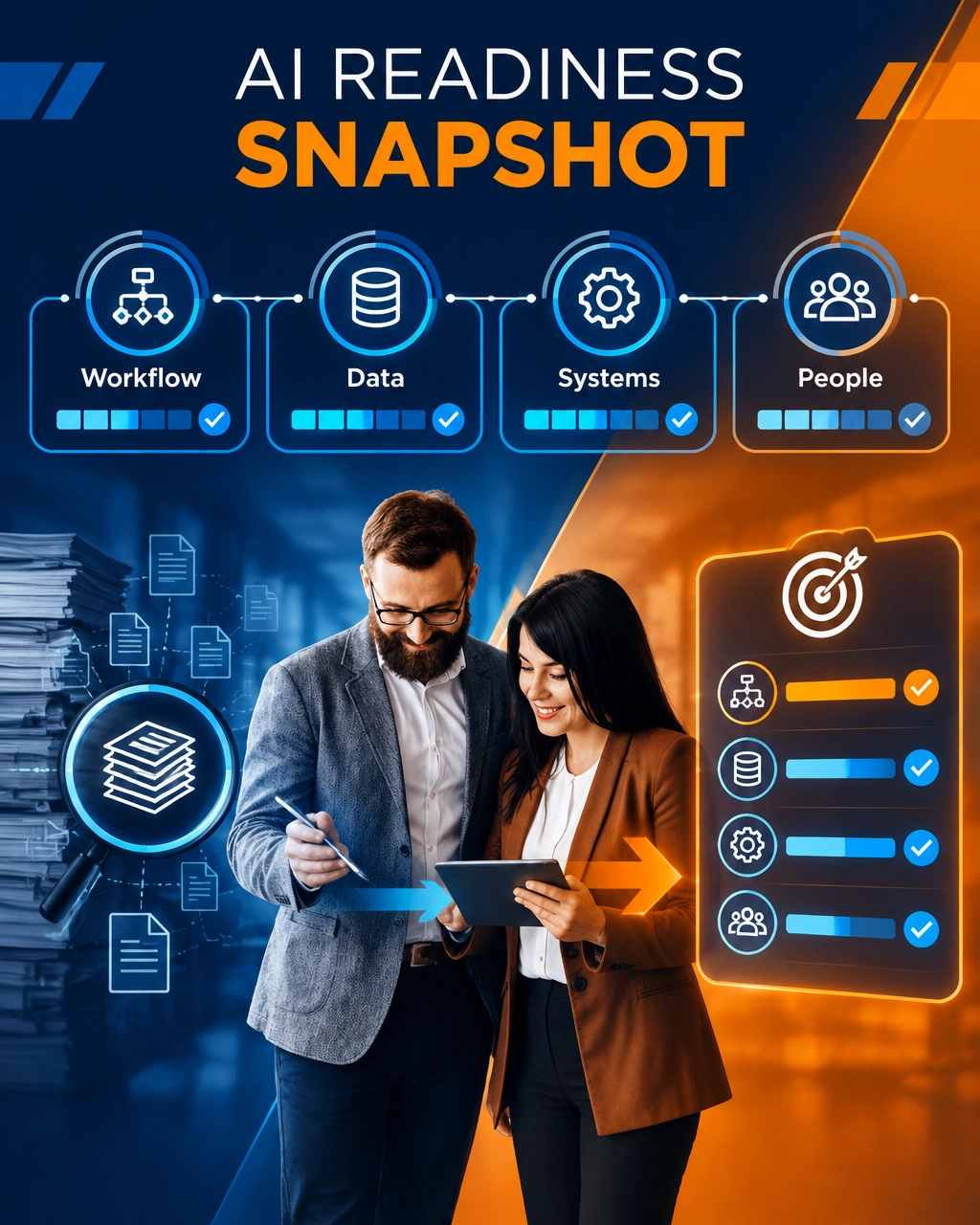
An AI Opportunity Audit should examine:
- Current business processes and operational bottlenecks
- Manual handoffs and repetitive decision points
- Data quality, accessibility, and ownership
- Existing CRM, ERP, HR, finance, and knowledge systems
- Regional variations in processes and regulations
- Potential risks associated with autonomous action
- Expected costs, benefits, and implementation dependencies
The outcome should be a prioritized opportunity map: not a generic list of chatbot ideas.
Your partner should distinguish between:
- Quick wins that can be tested with limited disruption
- Strategic opportunities requiring broader process redesign
- Low-value or high-risk use cases that should be postponed or rejected
A robust audit connects every proposed use case to measurable outcomes such as cycle-time reduction, fewer errors, improved service levels, lower operating costs, or stronger compliance.
This is where MOHBILITY’s Business Performance Analysis approach is especially relevant. Data-driven analysis can reveal where intelligent automation will create genuine value and where process improvement should come before technology adoption.
2. Test Their Business Process Optimization Capability
Agentic AI creates the greatest value when it improves an entire workflow: not when it automates one isolated task.
Ask prospective partners to demonstrate how they would analyze a process such as:
- Global order-to-cash
- Procurement and supplier management
- Contract review and due diligence
- Cross-border customer support
- Compliance reporting
- Financial reconciliation
- Supply-chain exception management
- Investment analysis and portfolio monitoring
A capable partner will map the current state, identify constraints, and redesign the workflow around the appropriate balance of human and agentic activity.
Look for evidence that the firm can:
- Model end-to-end value streams
- Identify process dependencies and failure points
- Define where human approval is mandatory
- Standardize global processes while allowing regional flexibility
- Establish KPIs before implementation
- Support adoption, training, and change management
Reject one-size-fits-all proposals. Your operating environment, data maturity, risk tolerance, and regional requirements are unique. Your solution should be equally tailored.
3. Compare Governance and Risk Capabilities
For multinational organizations, governance is not a later-stage compliance exercise. It is an architectural requirement.

Your consulting partner should provide a clear framework for:
- Identity and role-based access
- Data residency and cross-border data movement
- Encryption and secure API access
- Audit logs and traceable agent actions
- Human-in-the-loop approval thresholds
- Escalation, rollback, and shutdown procedures
- Model and workflow performance monitoring
- Vendor, tool, and plug-in risk
- Regulatory obligations across jurisdictions
Ask direct questions:
- How do you prevent an agent from accessing data outside its authority?
- How are high-impact actions reviewed or approved?
- Can we reconstruct what the agent did and why?
- How do you monitor model drift and unexpected behavior?
- How will your framework adapt to requirements such as GDPR or the EU AI Act?
A trustworthy partner answers these questions with documented methods, not vague assurances. Integrity, transparency, and accountability should be visible in the proposed architecture and contract.
4. Verify Integration and Implementation Depth
An agent is only as effective as the systems it can access securely and reliably.
Your partner should be able to integrate with the systems that run your business, including:
- CRM and customer service platforms
- ERP and finance systems
- Procurement and supply-chain applications
- Data warehouses and analytics platforms
- Internal knowledge bases
- Cloud and hybrid infrastructure
- Legacy systems with limited API support

Ask to see production examples: not only architecture diagrams or prototypes. Explore how the partner handles:
- API failures and rate limits
- Inconsistent or incomplete data
- Authentication and permissions
- Regional system differences
- Testing and quality assurance
- Monitoring after deployment
- Changes to upstream systems
The best partner owns the engagement from discovery through operations. Clear service-level agreements, incident response procedures, and continuous improvement plans provide the peace of mind that a pilot-only provider cannot.
MOHBILITY’s Back Office Automation services reflect this assessment-to-implementation model: understand the process, customize the solution, integrate it with existing systems, test it, train users, and monitor performance.
5. Demand Production Evidence and Knowledge Transfer
Agentic AI consulting is still an emerging discipline. Many providers have strong presentations but limited production history.
During due diligence, ask:
- How many agentic systems are currently live?
- How long have they operated in production?
- What measurable results have they achieved?
- What failures or unexpected behaviors have they managed?
- Who will be assigned to our engagement?
- How stable is the delivery team?
- What happens after go-live?
Also clarify ownership before signing:
- Who owns the source code?
- Who owns prompts, workflows, and documentation?
- Can your internal team modify the system?
- What training and knowledge transfer are included?
- Are you dependent on a particular platform or vendor?
A strategic partner should help you build internal capability: not create unnecessary dependency. Knowledge transfer is an essential part of sustainable transformation.
A Practical Shortlist of Red Flags
Remove a potential partner from consideration if you see any of the following:
- They lead with technology before understanding your processes
- They cannot provide production references or measurable KPIs
- They treat security and governance as a future phase
- They recommend a platform without explaining alternatives
- They promise full autonomy without human oversight
- They cannot explain how the agent will integrate with your systems
- They provide no post-deployment monitoring model
- They avoid clear answers about IP ownership
- They offer a generic roadmap for every client
- They focus on a pilot without defining the path to scale
These signals indicate a provider focused on delivering a project rather than building a long-term operating capability.
The Best Partner Is a Trusted Transformation Guide
Selecting the best Agentic AI consulting partner is ultimately a decision about trust.
You need a firm that can steer complex decisions, identify practical opportunities, manage risk, and remain accountable after implementation. You need a partner that combines AI Consulting, global management expertise, data-driven analysis, and disciplined execution.
The right approach is:
- Conduct an AI Opportunity Audit.
- Map and prioritize business processes.
- Compare partners using weighted criteria.
- Validate governance and integration capability.
- Review production evidence and references.
- Confirm ownership, support, and knowledge transfer.
- Begin with a measurable, scalable use case.
MOHBILITY helps businesses transform complexity into a clear path forward through tailored technology advisory, performance analysis, automation, and implementation support. Our goal is not to add AI for its own sake. It is to help you maximize returns, minimize risks, and unlock sustainable global performance.
Start with evidence. Choose with discipline. Build for measurable value.