AI Readiness Snapshot: What 30 Minutes of Discovery Should Reveal About Your Business
Artificial intelligence can help your business respond faster, reduce administrative work, improve consistency, and unlock new capacity. But deciding where to begin can feel complex: especially when you are running a local service business with 5–100 employees, limited time, and no internal AI team.
You do not need to begin with an expensive platform or a sweeping transformation program.
You need a clear diagnosis.
The AI Readiness Snapshot is a free 30–45 minute discovery conversation and scorecard designed to show you where AI and automation may create practical value first. It helps you move from uncertainty to a focused plan built around your actual operations, data, people, and technology.
Why an AI-first conversation is not enough
Many businesses start with a tool. They see an AI application, chatbot, or automation platform and immediately ask, “How can we implement this?”
That is often the wrong first question.
The more important questions are:
- Which business processes consume the most avoidable time?
- Where are employees repeating the same manual steps?
- Which workflows create delays, errors, or inconsistent customer experiences?
- Is the necessary data accessible and reliable?
- Can your current systems support integration?
- What level of automation is appropriate for your risk, budget, and team?
A one-size-fits-all approach can create unnecessary cost and operational disruption. The AI Readiness Snapshot takes a tailored, diagnose-first approach. It connects technology decisions to measurable business outcomes.
The goal is not to force AI into every part of your company. The goal is to identify where it can responsibly improve performance.
What the AI Readiness Snapshot includes
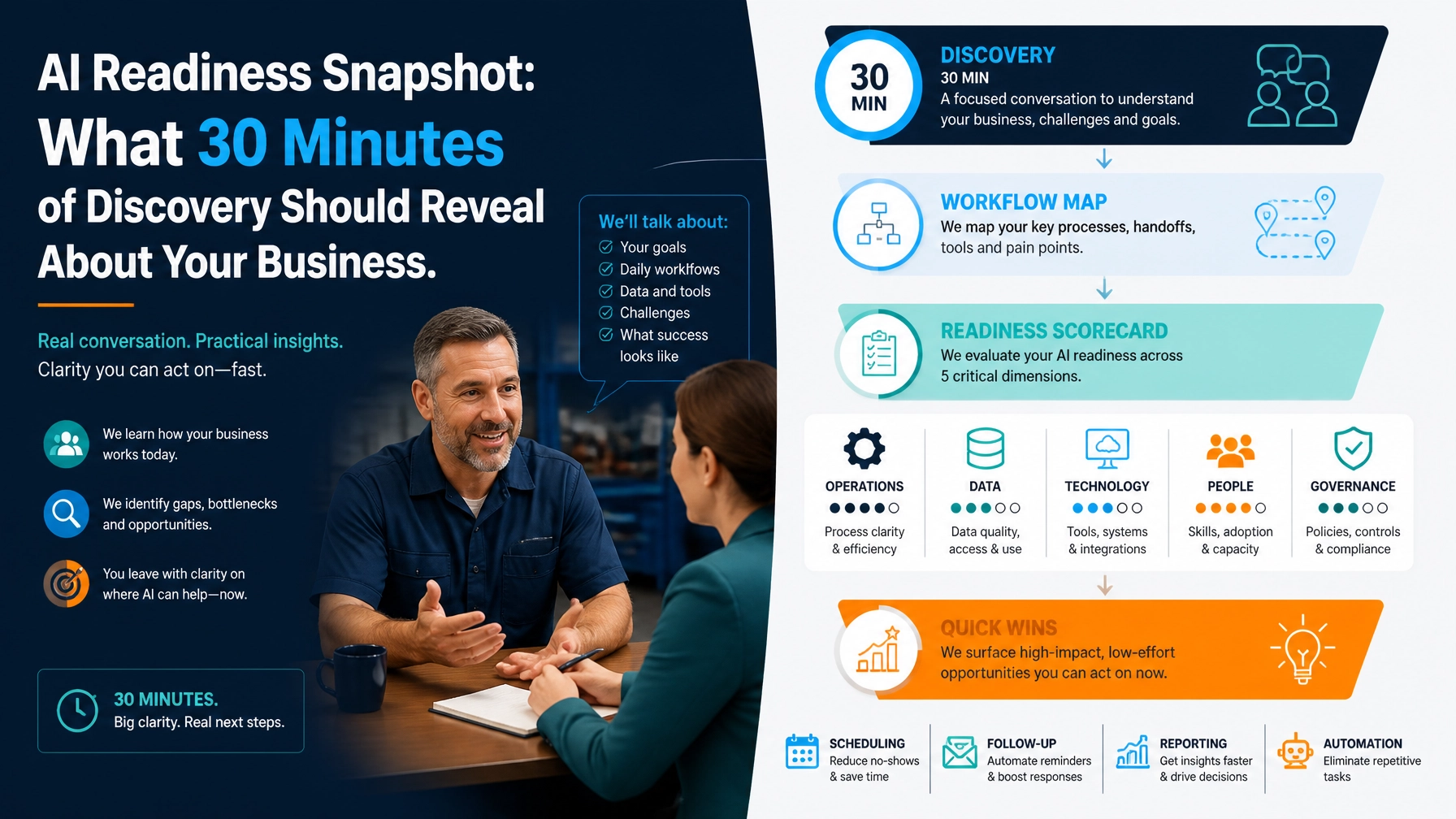
The Snapshot combines a focused discovery conversation with a practical scorecard. In a short session, you should leave with a clearer view of four things:
- Your most promising AI and automation opportunities
- The repetitive tasks that may be suitable for improvement
- The operational foundations you need before scaling
- A prioritized roadmap for next steps
The process is designed for owner-led businesses such as:
- Home services companies
- Professional services firms
- Property management businesses
- Healthcare and wellness practices
- Specialty contractors
- Logistics and field-service operators
- Local financial, legal, or administrative service providers
Your business does not need to be digitally mature to benefit. It needs a real operational challenge worth solving.
What should be covered in 30–45 minutes?
A productive Snapshot is structured, not vague. It should respect your time while asking enough detailed questions to identify meaningful opportunities.
1. Business context and priorities
The conversation begins with your objectives: not with a product demonstration.
You may discuss:
- Where growth is currently constrained
- Which administrative tasks absorb owner or employee time
- Where customers experience delays
- Which workflows depend too heavily on one person
- What you want to improve over the next 6–12 months
- How you currently measure efficiency, quality, and responsiveness
This establishes the business case. AI should support a defined outcome, such as faster quote turnaround, fewer missed leads, lower administrative burden, or improved scheduling capacity.
2. Repetitive-task opportunities
The Snapshot then examines workflows that may be consuming valuable time without requiring much judgment.
Common examples include:
- Appointment scheduling and reminders
- Customer inquiry routing
- Lead intake and qualification
- Quote or proposal preparation
- Invoice creation and follow-up
- Weekly reporting
- Document classification
- Data entry across multiple systems
- Email drafting and response triage
- Customer follow-up after completed work
Not every repetitive task should be automated. Some involve sensitive information, complex exceptions, or important human relationships.
The objective is to distinguish between:
- Tasks that can be automated immediately
- Tasks that need process improvement first
- Tasks where AI can assist employees but should not make final decisions
- Tasks that should remain human-led
That distinction protects quality while helping you identify quick wins.

How the scorecard evaluates your business
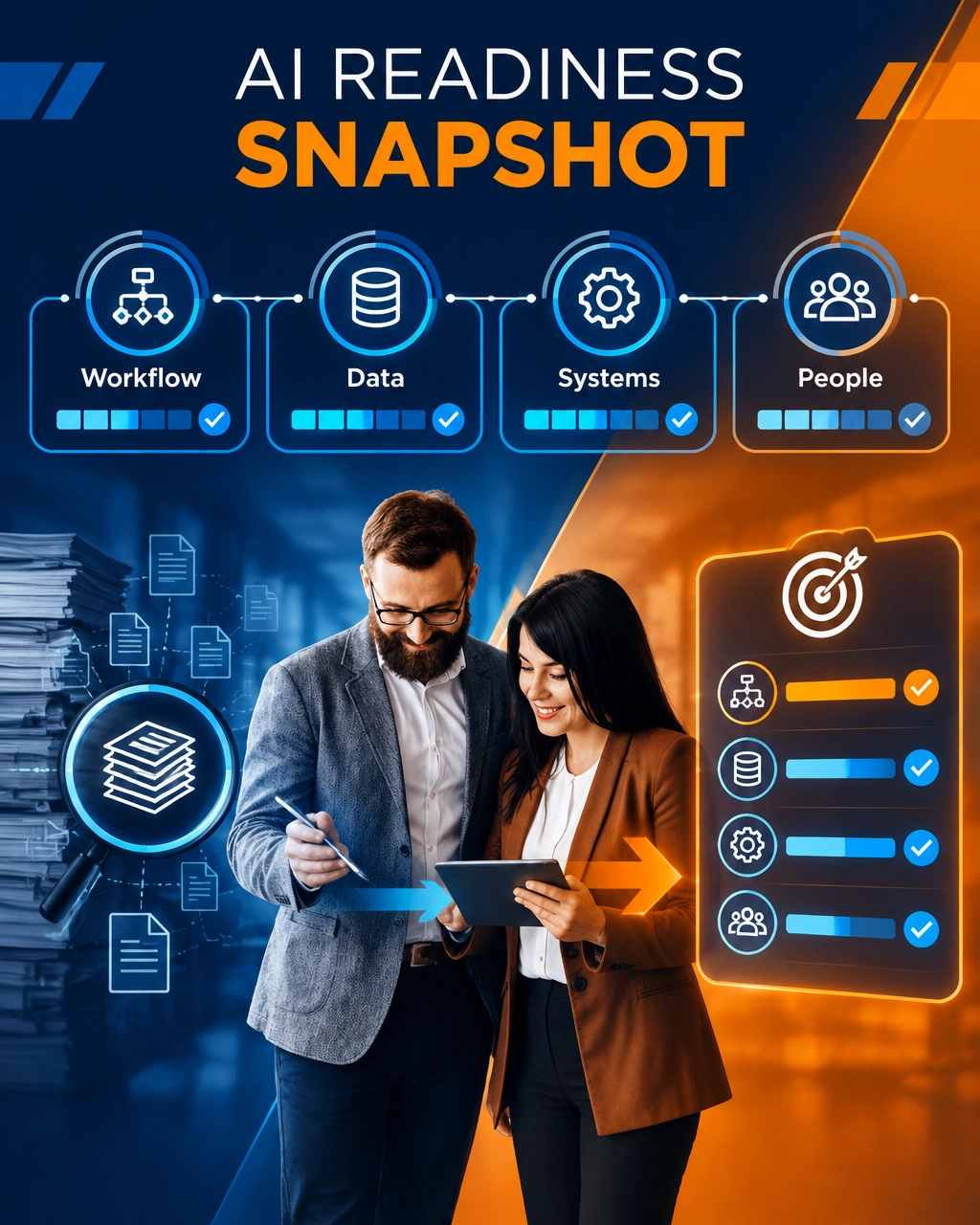
A useful readiness scorecard should be simple enough to understand and robust enough to guide decisions. The AI Readiness Snapshot evaluates several dimensions that influence whether an AI initiative can deliver sustainable value.
Operations and process maturity
Are your key workflows documented and reasonably consistent?
A process that changes every time a different employee performs it may not be ready for full automation. The first step may be to document the workflow, clarify ownership, and establish the correct sequence of activities.
Data readiness
Can you locate, access, and use the information needed for the workflow?
The review may consider:
- Where your data is stored
- Whether information is complete and current
- Whether systems use consistent formats
- How easily data can be exported or connected
- Whether sensitive data requires additional controls
AI outputs are only as reliable as the information and processes supporting them.
Technology and integration
Do your existing tools work together?
Your CRM, accounting platform, scheduling system, email tools, shared drives, and other applications may already contain the foundations for automation. The Snapshot helps identify available integration options, limitations, duplicate systems, and potential technology gaps.
This is where a technology assessment and strategy development perspective can prevent disconnected investments.
People and change readiness
Will your team adopt the solution?
Successful implementation depends on more than software. Your employees need to understand:
- What the technology will change
- Which tasks it will support
- How human review will work
- What new skills may be required
- How performance will be measured
A practical solution should empower your team, not create confusion or unnecessary resistance.
Governance, privacy, and risk
Can you use AI responsibly?
The Snapshot considers the safeguards needed for your business, including:
- Data privacy
- Security and access controls
- Customer confidentiality
- Human approval requirements
- Acceptable-use policies
- Regulatory or contractual obligations
- Accountability for AI-assisted decisions
Integrity, transparency, and accountability should be part of the design from the beginning: not added after implementation.
What your Snapshot should reveal
A meaningful result is more than a score. It should translate findings into decisions.
Quick wins
You should receive a view of opportunities that are relatively low in complexity but potentially meaningful in impact.
For example:
- Automating appointment reminders
- Routing incoming inquiries
- Creating draft responses for common questions
- Generating recurring internal reports
- Extracting information from standard forms
- Connecting lead intake to your CRM
Quick wins create momentum while limiting operational risk.
High-value repetitive workflows
The Snapshot should identify the processes where automation may create the greatest benefit. Each opportunity should be evaluated according to factors such as:
- Time currently spent
- Volume and frequency
- Error or rework rates
- Customer impact
- Data availability
- Integration requirements
- Security and compliance considerations
- Ease of measuring results
This helps you avoid pursuing impressive but impractical use cases.
An automation roadmap
You should leave with a sequenced plan, not a list of disconnected ideas.
A practical roadmap may include:
- Immediate opportunities that can be tested with limited disruption
- Foundation work involving process documentation, data cleanup, or system integration
- Pilot initiatives with defined owners and success metrics
- Expansion opportunities that can be considered after results are validated
The roadmap should clarify what to do first, what to defer, and why.
The diagnose-first path to AI adoption
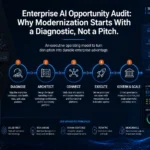
The AI Readiness Snapshot is the starting point in a broader transformation pathway:
- Diagnose: Understand your operations, readiness, risks, and highest-value opportunities.
- Architect: Design a tailored solution, target workflow, data approach, and implementation plan.
- Connect: Integrate the right systems, information sources, and automation tools.
- Execute: Launch a controlled pilot, train users, and measure performance.
- Govern & Scale: Establish oversight, improve the solution, and expand responsibly.
This sequence matters. It gives you a disciplined way to move from experimentation to operational value.
How to prepare for your Snapshot
You do not need to prepare a lengthy presentation. Bring practical context.
Before the conversation, consider:
- Which tasks your team repeats every day or week
- Where work is delayed or frequently corrected
- Which systems employees use most often
- Where customer response times could improve
- Which reports or documents take too long to produce
- Any privacy, security, or regulatory concerns
- One business outcome you want to improve
Honest answers are more valuable than polished ones. The purpose is to understand how work actually gets done.
How the Snapshot differs from the Enterprise AI Opportunity Audit
The AI Readiness Snapshot is a free, focused discovery and scorecard for SMBs. It is designed to help you identify practical opportunities and determine whether your business is ready for an initial AI or automation initiative.
The Enterprise AI Opportunity Audit is a separate paid engagement, typically priced at $15,000–$35,000. It is intended for larger or more complex organizations that require a comprehensive examination of enterprise processes, systems, data architecture, governance, opportunity economics, and implementation priorities.
The two offers serve different needs:
- AI Readiness Snapshot: Fast SMB diagnosis, scorecard, quick wins, and initial roadmap
- Enterprise AI Opportunity Audit: Deep, paid enterprise analysis and strategic opportunity assessment
The Snapshot does not replace the Enterprise AI Opportunity Audit. It provides an appropriate starting point for owner-led businesses that need clarity before making a larger commitment.
Take the first practical step
AI adoption does not have to be overwhelming. You can begin with one workflow, one measurable outcome, and one carefully designed improvement.
The AI Readiness Snapshot helps you understand where to focus, what to prioritize, and which risks to address before investing in broader transformation.
You do not need a perfect system. You need a clear diagnosis and a trusted partner who can help you steer the next decision with confidence.
Book your AI Readiness Snapshot. Identify your highest-value opportunity. Build from evidence.
For additional perspective, review the SME AI readiness resources from the OECD, the AWS AI readiness checklist for small and midsize businesses, and the organization’s broader technology work.