

Contact Us

+1-469-459-0793

agent@mohbility.com

USA - Canada - Africa - Asia - Europe - UAE

Top

Cloud Computing & DevOps Automation

In today’s fast-paced digital landscape, speed, scalability, and reliability aren't just advantages, they are necessities. By uniting the infinite scalability of Cloud Computing with the frictionless efficiency of DevOps Automation, businesses can transform how they build, deploy, and scale software.

Cloud Computing: The Foundation of Modern Infrastructure

Cloud computing eliminates the burden of managing physical hardware, allowing teams to provision resources on demand. Whether you utilize AWS, Microsoft Azure, or Google Cloud Platform (GCP), the cloud provides the ultimate sandbox for rapid growth.

Elastic Scalability: Automatically scale your infrastructure up or down based on real-time traffic, ensuring optimal performance without overpaying.

High Availability & Resilience: Leverage global data centers to architect redundant, fault-tolerant systems with near-zero downtime.

Cost Optimization: Shift from heavy upfront capital expenditures (CapEx) to a flexible, pay-as-you-go operational expense (OpEx) model.

Speak to an Advisor

DevOps Automation: Eliminating Friction

DevOps is more than a cultural shift, it is an engineering discipline powered by automation. By automating repetitive tasks, your development and operations teams can focus on delivering actual business value

Continuous Integration & Continuous Deployment (CI/CD): Automate your build, test, and deployment pipelines to ship code to production multiple times a day with absolute confidence.

Infrastructure as Code (IaC): Treat your infrastructure exactly like application software. Define networks, servers, and databases using code (e.g., Terraform, Ansible) for repeatable, error-free environments.

Automated Monitoring & Observability: Detect and resolve anomalies before they affect users using proactive logging, metrics, and alerting frameworks.

Speak to an Advisor

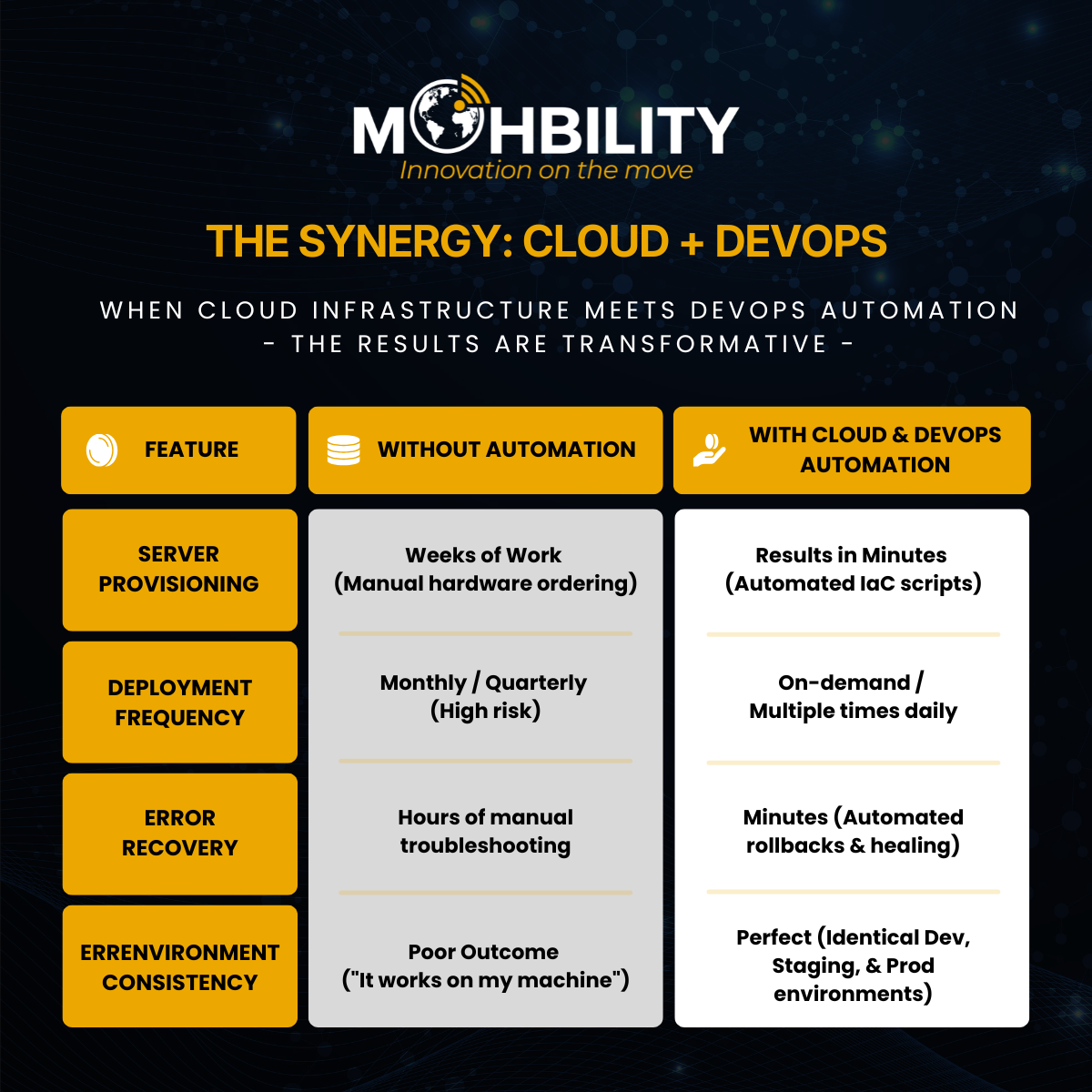
The Synergy: Cloud + DevOps When cloud infrastructure meets DevOps automation, the results are transformative:

Developing IoT technology for MOHBILITY, an entity focused on mobility solutions, involves several tailored steps to ensure the technology is robust, user-friendly, and meets the specific needs of mobility applications.

Get Started Now
Connectivity and Communication

IoT devices need to communicate, often wirelessly, with other devices or a central server. This involves setting up communication protocols like Wi-Fi, Bluetooth, Zigbee, or cellular networks.

Data-Driven Decisions

Our IoT solutions empower you with actionable insights. By harnessing the power of data analytics, we provide you with the tools to make informed decisions, optimizing performance and user experience.

Security and Compliance

We prioritize your safety and privacy. Our solutions are built with top-tier security protocols and comply with all relevant privacy regulations, ensuring your data is protected every step of the way.

Data Management and Analytics

Offering advanced tools for data collection, processing, and analytics to drive efficiency and innovation.

Our Case Studies

Join the ranks of satisfied clients who have transformed their operations with MOHBILITY. It's time to make data work for you. Unlock your business's full potential with MOHBILITY.

Our Approach

Needs Assessment and Scope Definition

  • Identify Mobility Challenges: Understand the specific mobility challenges that MOHBILITY aims to address. This could involve enhancing transportation efficiency, improving accessibility for individuals with mobility impairments, or integrating smart mobility solutions.
  • Define Scope: Clearly define the scope of the IoT project, including its objectives, target users, and the specific problems it aims to solve within the mobility sector.

Research and Feasibility Study

  • Market Analysis: Conduct a thorough market analysis to understand current trends, competitors, and potential customer needs in the mobility sector.
  • Technology Feasibility: Evaluate the feasibility of various IoT technologies (sensors, connectivity options, etc.) for mobility applications.

Design and Prototyping

  • System Architecture Design: Design the overall system architecture, including hardware (sensors, devices) and software (data processing, user interface).
  • Prototyping: Develop prototypes to test concepts and refine the design. This might include vehicle integration for mobility solutions.
Get Started Now

The Ultimate Guide to Business Intelligence Automation for Startups

A History of Money, Cryptocurrency, and Blockchain

Blockchain Basics

The Business of Blockchain

Proof of Work vs. Proof of Stake

Benefits of Blockchain Technology

Risks and Challenges of Blockchain Technology

Deciding if Blockchain Technology is Right for You

Blockchain Implementation Mistakes to Avoid

DOWNLOAD E-BOOK
REGISTER FOR LIVE Q&A

Join a Global Network of Industry Experts and Partners to Support Business Growth

Join Now