

Seed to Series B in 3–9 Months: Building an Institutional-Grade Fundraise Timeline
Fundraising is rarely difficult because you lack ambition. It is difficult because institutional investors evaluate your company through multiple lenses at once: growth quality, market potential, financial discipline, governance, technology, and execution risk.
If your next raise is 3–9 months away and your pitch deck already exists: but does not yet meet institutional expectations: you have a meaningful opportunity. A structured process can transform fundraising from a reactive search for capital into a carefully managed strategic transaction.
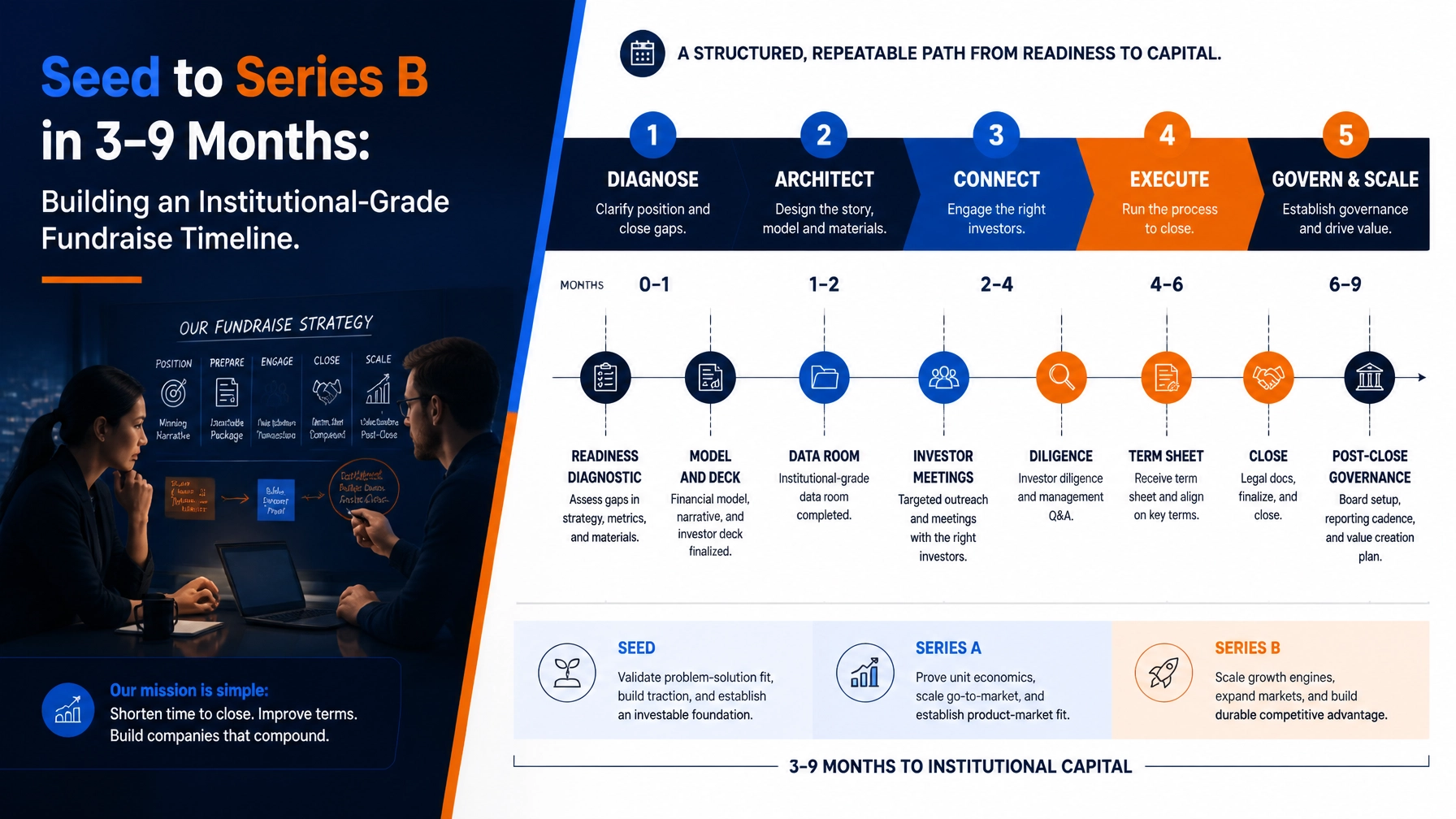
This guide shows you how to build that process across five stages:
- Diagnose
- Architect
- Connect
- Execute
- Govern & Scale
There is no one-size-fits-all fundraising timeline. Your stage, runway, market, geography, revenue profile, and capital requirements all matter. However, the framework below gives you a robust starting point for building an investor-ready process.
Why a 3–9-Month Fundraise Requires Early Preparation
A venture fundraise commonly includes preparation, investor targeting, outreach, meetings, term sheet negotiation, due diligence, and closing. Depending on the round and complexity of the transaction, the process may take several months from initial preparation to funds wired.
Research from Growth CFO and OpenSeed highlights the importance of reverse-planning from your runway and desired close date.
You should not begin when cash is nearly exhausted. You should begin while you still have negotiating leverage.
Your planning should answer:
- When will you reach your minimum cash threshold?
- What milestones must the new capital fund?
- How much runway should the round provide?
- Which metrics must improve before investor outreach?
- Which investors can realistically lead or participate?
- What delays could arise during legal or commercial diligence?
A 3–9-month horizon is sufficient for a disciplined raise. It is not sufficient for indecision.
Stage 1: Diagnose Your Investment Readiness
The first step is not redesigning your deck. It is diagnosing whether your business can withstand institutional scrutiny.
An institutional-grade raise requires alignment between your story, metrics, documents, and capital strategy. If one element is weak, investors may interpret the inconsistency as execution risk.
Assess the four readiness layers
1. Commercial readiness
Investors want to understand whether demand is repeatable and scalable.
Review:
- Revenue growth and quality
- Customer concentration
- Retention, churn, and expansion
- Sales pipeline and conversion
- Pricing and gross margin
- Sales cycle and payback period
- Market size and competitive differentiation
2. Financial readiness
Your financial model should explain how capital converts into measurable outcomes.
It should include:
- Historical performance
- Base, upside, and downside scenarios
- Headcount and operating assumptions
- Cash burn and runway
- Unit economics
- Use of funds
- Milestones tied to the next financing event
3. Operational and technology readiness
At Series A and Series B, investors increasingly examine whether your systems can support growth without disproportionate risk.
Evaluate:
- Product scalability
- Technical debt
- Cybersecurity controls
- Data governance
- Infrastructure resilience
- Key-person dependency
- Organizational structure
- Hiring priorities
4. Legal and governance readiness
A clean cap table and organized legal records communicate integrity, transparency, and accountability.
Prepare to validate:
- Founder and employee equity
- Option pool documentation
- Intellectual property assignments
- Customer and supplier contracts
- Prior financing documents
- Regulatory obligations
- Data protection practices
- Board and shareholder records
For additional guidance on data-driven decision-making, review the Ultimate Guide to Business Performance Analysis. For operational and governance considerations, the Ultimate Guide to Business Operational Structure for Startups is also relevant.
Stage 2: Architect the Fundraise Before You Approach Investors
Once you know your gaps, build the fundraising architecture. This is where you determine what you are raising, why you are raising it, and how the round advances the company.
Define the capital strategy
Your target raise should be connected to milestones: not simply to a preferred valuation or an attractive headline number.
For example:
- Seed: Prove early repeatability, product-market signals, and initial customer demand.
- Series A: Demonstrate scalable go-to-market performance and improving unit economics.
- Series B: Strengthen market position, expand operational capacity, and establish a credible path toward category leadership.
Use your model to determine:
- The amount required to fund 12–24 months of operations
- The minimum viable round size
- The milestone-based upside case
- The maximum dilution you can responsibly accept
- The timing required to reach the next financing inflection point
Your capital strategy should also account for cross-border considerations. International investors may bring valuable global networks, but they may also require additional diligence around tax, ownership, regulatory exposure, data flows, and entity structure.
Upgrade the pitch deck
A deck can be visually polished and still fail to answer the questions institutional investors ask.
Your deck should clearly communicate:
- The problem and why it matters now
- Your differentiated solution
- The size and structure of the market
- Evidence of demand
- Your business model
- Growth and retention metrics
- Go-to-market strategy
- Competitive advantages
- Team capability
- Financial performance and projections
- Capital requirements
- Specific use of funds
- The milestones the round will unlock
At Seed, investors may focus on early repeatability, engagement, and founder-market fit. At Series A, they will expect stronger evidence of product-market fit and scalable distribution. At Series B, they will examine market leadership, organizational depth, margins, and operational excellence.
The deck is not a data room. It is the narrative that earns the next conversation. Every material claim must be supported by evidence you can provide quickly.
Build the data room early
Do not wait for a term sheet to organize your documents. Missing or inconsistent information can slow momentum and undermine confidence.
Your data room may include:
- Financial statements
- Detailed financial model
- KPI definitions and dashboards
- Cohort and retention analyses
- Customer and pipeline information
- Product roadmap
- Architecture and security documentation
- Commercial agreements
- Employment and equity records
- Cap table
- Corporate and financing documents
- Compliance policies
The Raise Ready framework and SVB’s overview of venture capital stages provide useful context for aligning materials with investor expectations.
Stage 3: Connect With the Right Investors
Investor matching is not a volume contest. Sending your deck to every fund with a visible email address creates noise, consumes time, and can weaken your positioning.
You need a tailored investor universe.
Score investors against practical criteria
For every target investor, assess:
- Stage fit: Seed, Series A, or Series B
- Sector and business model expertise
- Geographic reach
- Typical check size
- Lead-investor capacity
- Ownership expectations
- Portfolio conflicts
- Follow-on reserves
- Relevant operating support
- Track record in comparable markets
A smaller, qualified list is usually more valuable than a large, undifferentiated database.
Your pipeline should track each investor through defined stages:
- Research
- Relationship building
- Introduction requested
- First meeting
- Partner meeting
- Diligence
- Term sheet
- Negotiation
- Close
Cluster outreach into a concentrated period where possible. A synchronized process helps create momentum, improves internal coordination, and gives you a clearer view of market feedback.
Warm introductions can help, but credibility must ultimately come from the quality of your business, evidence, and preparation. Your objective is not merely to secure meetings. It is to reach investors whose expertise, network, and capital base match the company you are building.
Stage 4: Execute a Month-by-Month Timeline
A practical 3–9-month process might look like this:
Months 1–2: Prepare and strengthen
- Complete an investment readiness diagnostic
- Confirm the raise objective and capital strategy
- Refresh the financial model
- Upgrade the pitch deck
- Define core metrics and reporting standards
- Build the institutional data room
- Resolve cap table, legal, and governance gaps
- Develop your investor target list
Months 3–5: Run the investor process
- Activate warm introductions
- Begin structured outreach
- Hold first meetings in a concentrated window
- Track feedback and recurring objections
- Conduct partner meetings
- Share tailored follow-up materials
- Maintain competitive process discipline
- Prepare for early diligence requests
Months 6–9: Negotiate, close, and transition
- Evaluate term sheets beyond headline valuation
- Review board rights and protective provisions
- Assess liquidation preferences and investor controls
- Complete commercial, financial, technical, and legal diligence
- Negotiate definitive agreements
- Coordinate signatures and closing conditions
- Confirm funds are wired
- Translate the financing plan into an operating roadmap

The timeline may compress or extend. A highly prepared Seed round could close faster. A complex Series B involving multiple jurisdictions, larger checks, or extensive diligence may require more time.
Build contingency into the plan. A timeline without buffer is a risk model, not a strategy.
Stage 5: Govern and Scale After the Close
The financing is not the finish line. It is a new accountability structure.
Your investors will expect disciplined reporting and visible progress against the milestones presented during the raise. Establish a governance rhythm immediately.
This may include:
- Monthly KPI reporting
- Quarterly board materials
- Budget-versus-actual analysis
- Hiring and deployment tracking
- Risk and compliance reviews
- Customer concentration monitoring
- Updated cash and runway forecasts
- Milestone reviews tied to capital deployment
Strong governance gives you more than investor confidence. It gives you operating clarity.
It also positions you for future international investments, strategic partnerships, acquisitions, and expansion into new markets. The systems you build during one round become part of the institutional foundation for the next.
The Right First Move: Diagnose Before You Connect
If your fundraise is 3–9 months away, do not start with mass outreach. Start with a rigorous view of your readiness.
A structured engagement can help you:
- Identify gaps in your narrative, metrics, and documentation
- Architect a milestone-based capital strategy
- Build an institutional-grade pitch deck and data room
- Match with investors aligned to your stage and ambitions
- Establish a disciplined execution and governance process
The first step is the Investment Readiness Diagnostic. From there, the Founder Readiness Sprint provides a tailored path for founders and executive teams preparing for a Seed through Series B raise. Engagements are typically structured in the $7,500–$15,000 range, depending on scope and complexity.
Your fundraise should reflect the quality of the company you are building.
Diagnose the gaps. Architect the strategy. Connect with the right capital. Execute with confidence. Govern for scale.
When the stakes are high, preparation is not overhead. It is leverage.