

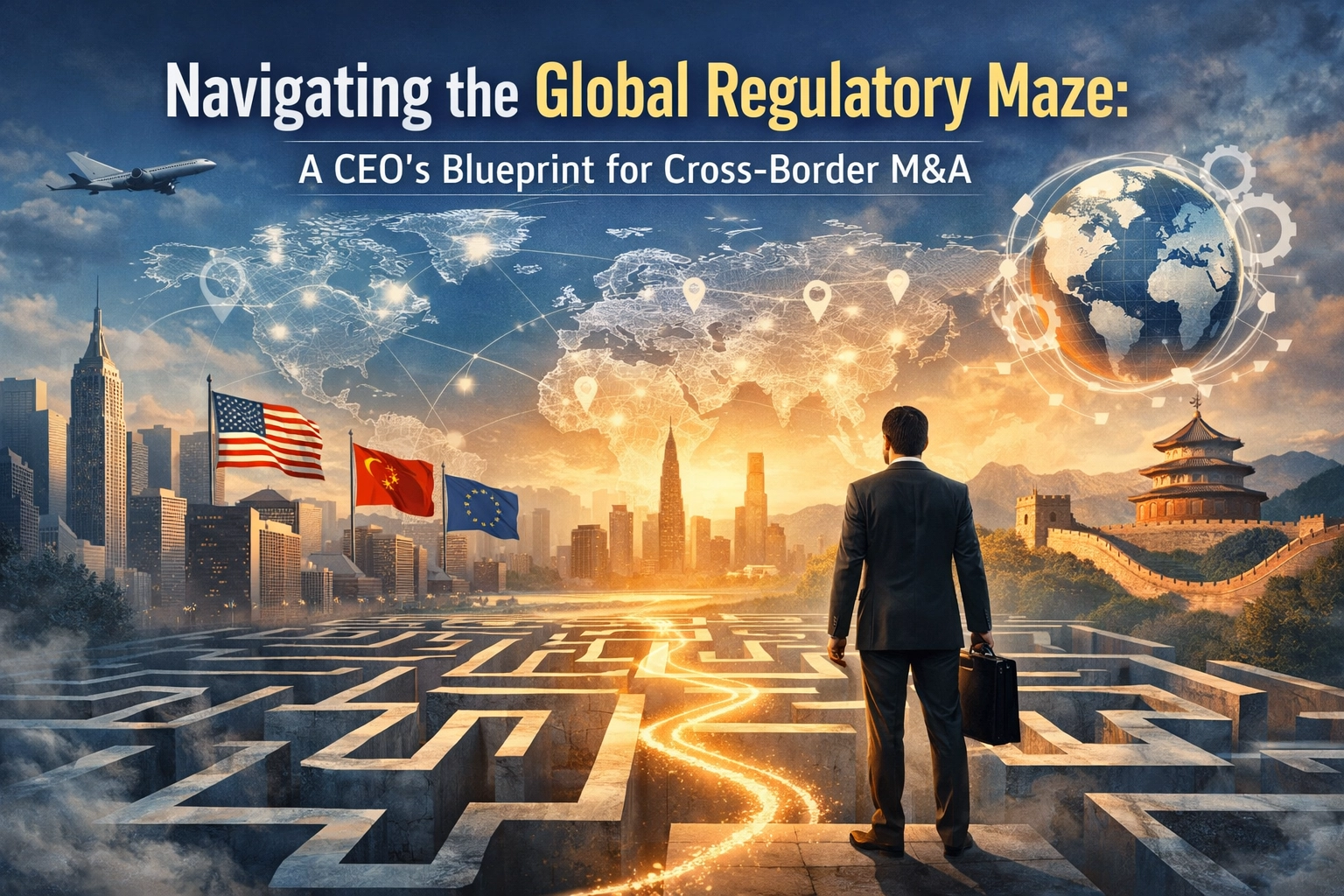
Navigating the Global Regulatory Maze: A CEO’s Blueprint for Cross-Border M&A
In the current landscape of 2026, the mandate for growth has never been clearer, yet the path to achieving it through cross-border Mergers and Acquisitions (M&A) has never been more intricate. You are operating in a market where M&A activity has surged to a staggering $4.6 trillion globally. While the opportunities for expansion are vast, the regulatory environment has evolved into a sophisticated maze of shifting thresholds, heightened antitrust scrutiny, and national security mandates.
For a CEO, a cross-border deal is no longer just a financial or operational calculation; it is a high-stakes diplomatic and legal maneuver. The "one-size-fits-all" integration strategies of the past decade are obsolete. To succeed today, you need a meticulous, proactive strategy that anticipates regulatory friction before it halts your momentum. At MOHBILITY, we specialize in guiding executives through these complexities, ensuring that your international ambitions are met with seamless execution rather than costly litigation.
The Growing Complexity: Why Your Strategy Must Evolve
The days of assuming a deal will "clear" simply because the math works are gone. In 2026, regulators are not just looking at market share; they are examining data sovereignty, labor impact, and the long-term preservation of national innovation.
You are likely facing a "perfect storm" of regulatory factors:
- Aggressive Antitrust Intervention: Regulators in the US, EU, and UK are increasingly skeptical of "Big Tech" and AI-driven consolidations.
- National Security Barriers: Governments are treating critical minerals, semiconductors, and energy infrastructure as protected assets, often deploying state capital to block private acquisitions.
- Fragmented Compliance: New state-level filing requirements in the US and localized cultural requirements in Europe have added layers of bureaucracy that can extend deal timelines by months.
This complexity can be overwhelming, but it is not insurmountable. With the right blueprint, you can transform regulatory hurdles into competitive advantages.

Understanding the New 2026 Thresholds: HSR and Beyond
The first step in your blueprint is a robust understanding of the updated filing requirements. As of January 2026, the Hart-Scott-Rodino (HSR) filing thresholds have increased. The minimum transaction value threshold now stands at $133.9 million, up from the previous year. While this might suggest fewer federal reviews, the reality is the opposite.
The FTC and DOJ have shifted their focus toward "interlocking directorates" and smaller, "killer acquisitions" in the tech sector that may fall below these thresholds but still trigger intense scrutiny. You must empower your legal and deal teams to look beyond the top-line numbers.
MOHBILITY Key Insight: Do not wait for the "Size-of-Person" test to trigger a filing. Conduct a preemptive regulatory audit to identify potential antitrust triggers in niche markets where your combined entity might hold disproportionate influence.
Navigating the Sector-Specific Minefields
If your target operates in the realms of Artificial Intelligence, Media, or Chip Manufacturing, you are under a microscope. Regulators in 2026 are particularly concerned with how cross-border deals might export sensitive IP or create monopolistic data silos.
The National Security Mandate
The Committee on Foreign Investment in the United States (CFIUS) and its international counterparts have expanded their reach. We are seeing a trend where Western governments are deploying "State Capital" to secure access to critical materials. If you are competing against or acquiring an entity involved in the supply chain for critical minerals or defense-adjacent technology, you are no longer just negotiating with a seller: you are negotiating with a sovereign entity.
To mitigate this:
- Assess Jurisdiction Risk early: Map out every territory where the target has operations or significant data storage.
- Prepare for Structural Remedies: Be ready to offer divestitures or "firewall" agreements early in the negotiation process to signal transparency.
- Consult Experts: Utilize our insights to understand how geopolitical shifts are impacting specific industry verticals.

The Transatlantic Divide: EU vs. US Regulatory Philosophy
One of the most daunting challenges for a CEO is the divergence between American and European regulatory philosophies. While the US often focuses on consumer pricing and competitive harm, European and UK regulators are increasingly focused on the "local character" of the merged entity.
European authorities are scrutinizing whether a cross-border combination will result in a loss of local leadership, branding, or talent. They want to ensure that the "headquarters culture" remains rooted in their jurisdiction.
Your Blueprint for Success in Europe:
- Commit to Local Presence: Proactively outline your plans for maintaining local headquarters or R&D centers.
- Standardize Terms: To avoid a "patchwork" of compliance, work with a trusted partner like MOHBILITY to standardize transaction terms across jurisdictions, drawing from complex structured finance precedents.
- Anticipate Extended Timelines: Build "outside dates" into your contracts that reflect the reality of European regulatory timelines, which are often longer than US counterparts.
Strategic Deal Structuring: Carve-outs and Risk Allocation
When a full acquisition is too regulatory "hot," the most successful CEOs are turning to Corporate Carve-outs and complex participation structures. In 2026, we’ve seen a surge in sellers retaining a stake through "rollover equity" or seller financing. This allows the buyer to gain the desired assets while mitigating some of the immediate regulatory pressure associated with a 100% change in control.
At MOHBILITY, we help you maximize your ROI by structuring these carve-outs with surgical precision. Whether it is a business performance analysis to determine which assets to strip or a full case study review of similar cross-border maneuvers, we ensure you don't overpay for regulatory risk.
Risk Allocation Mechanisms
To give your board "peace of mind," your deal documents should include:
- Calibrated Reverse Termination Fees: Set these fees to reflect the current regulatory intensity. A higher fee can sometimes signal your confidence to the seller, but it must be balanced against the risk of a block.
- Mitigation Caps: Clearly define the extent to which you are willing to divest assets to satisfy regulators before you walk away from the deal.

Integrity and Transparency: The MOHBILITY Standard
Navigating a maze requires more than just a map; it requires a guide you can trust. At MOHBILITY, our mission-driven ethics are at the core of everything we do. We believe that transparency and accountability are not just buzzwords but essential components of a successful M&A strategy.
We reject the "one-size-fits-all" consulting model. Every cross-border deal has a unique pulse: a specific blend of cultural, legal, and financial nuances. We provide tailored solutions that respect the integrity of both the buyer and the target, ensuring a post-close environment that is ripe for synergy rather than friction.
Conclusion: Empower Your Global Vision
The global regulatory maze of 2026 is indeed complex, but for the prepared CEO, it is also a landscape of immense opportunity. By identifying risks early, embracing sophisticated deal structures, and partnering with experts who understand the global pulse, you can transform your business and unlock unprecedented value.
Don't let regulatory uncertainty stifle your growth. Steer your company with confidence.
Are you ready to blueprint your next international move?
Explore our Case Studies to see how we’ve helped leaders like you navigate the most challenging cross-border environments, or reach out to our team today to begin a comprehensive regulatory assessment of your portfolio.
Unlock your global potential with MOHBILITY: your trusted partner in high-stakes strategy.