

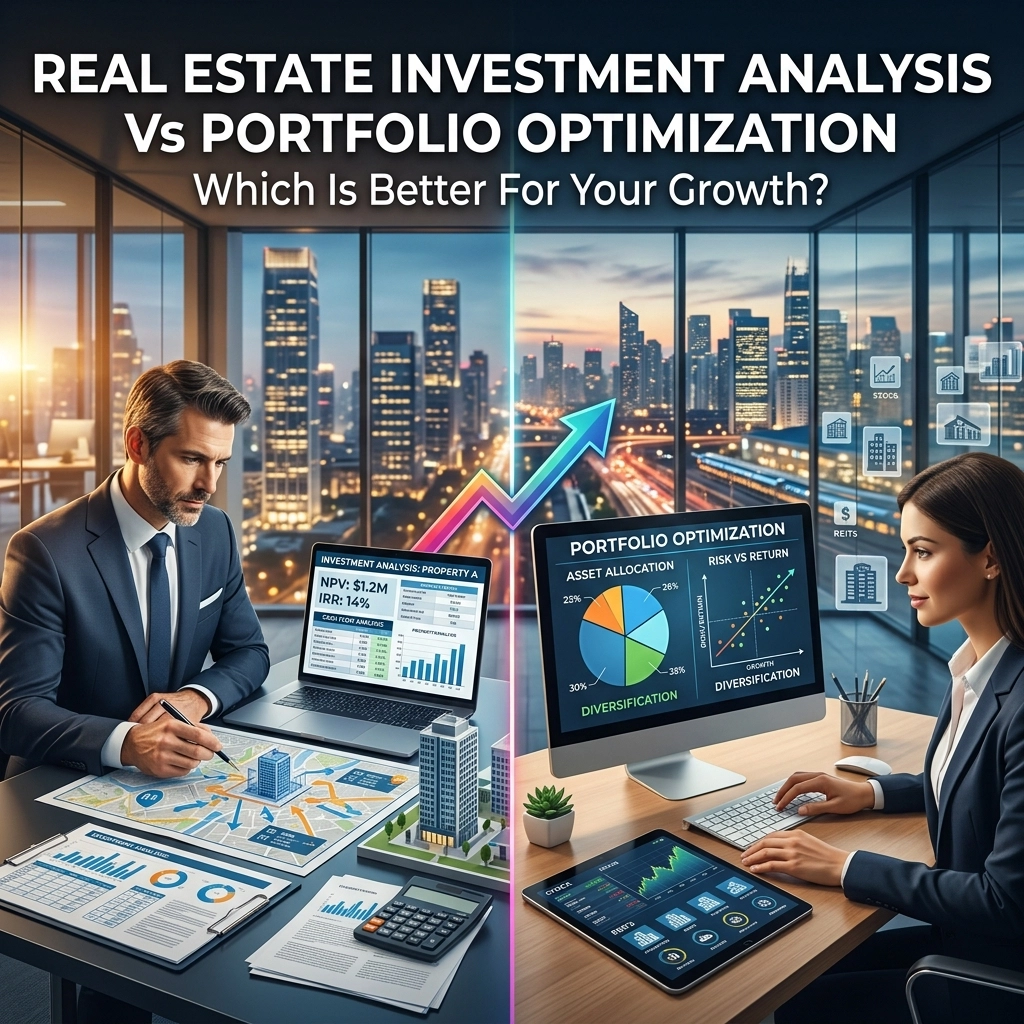
Real Estate Investment Analysis Vs Portfolio Optimization: Which Is Better For Your Growth?
You’ve reached a point where "buying more property" is no longer a simple Saturday afternoon hobby. It’s a high-stakes game of chess played across different time zones, currencies, and tax jurisdictions. As your holdings grow, so does the weight of the decisions you make. You might find yourself staring at a spreadsheet, wondering if you should deep-dive into the performance of a single commercial asset in London or step back and look at how your entire global collection is shielding you from market volatility.
This is the classic dilemma: Real Estate Investment Analysis (REIA) vs. Portfolio Optimization (PO).
While many investors use these terms interchangeably, they represent two very different levels of thinking. Choosing the wrong one for your current stage of growth can lead to stagnant returns or, worse, unmitigated risk. At MOHBILITY, we believe that understanding the nuance between these two is the key to unlocking global excellence.
The Micro View: What is Real Estate Investment Analysis?
Real estate investment analysis is the foundation. It is the meticulous process of looking at a specific asset: be it a multi-family complex, a logistics hub, or a retail space: and determining its individual viability.
When you conduct an analysis, you are asking "Is this building a good deal?" You are looking at:
- Net Operating Income (NOI): The baseline health of the asset.
- Cap Rates: How much yield are you getting relative to the purchase price?
- Internal Rate of Return (IRR): The annualized effective compounded return rate.
- Cash-on-Cash Return: The actual paper money entering your bank account relative to what you put in.
This approach is fundamentally diagnostic. It’s like a doctor checking your pulse; it tells you if the heart is beating, but it doesn’t tell you if you’re fit enough to run a marathon. For many, this level of business performance analysis is where they spend 90% of their time.
However, the problem with staying only at this level is the "silo effect." You might have ten "great" individual deals that, when combined, create a massive risk because they are all in the same city or all exposed to the same industry downturn.
 ]
]
The Macro View: The Power of Portfolio Optimization
If analysis is about the individual trees, Portfolio Optimization is about the entire forest. This is a proactive, forward-looking strategy that applies advanced analytics and financial models to ensure your assets work together as a cohesive unit.
Portfolio optimization asks a much harder question: "Does this asset make my entire portfolio stronger, or does it just add more of the same?"
At its core, optimization is about risk mitigation and return maximization. It involves:
- Strategic Rebalancing: Moving capital out of stagnating sectors and into high-growth opportunities.
- Correlation Analysis: Ensuring that if one market (say, US Tech) dips, another part of your portfolio (perhaps West African infrastructure) remains unaffected.
- Operational Synergies: Finding ways to reduce costs across multiple holdings through centralized management or technology.
For a look at how we’ve helped clients streamline complex operations, our work with PWMRealty serves as a robust example of how shifting focus from single-asset management to broad-scale strategy can transform results.
Diagnostic vs. Proactive: The Key Differences
To help you decide where your focus should be, let's break down the two approaches across three critical dimensions.
1. The Goal
- Analysis: Focuses on accuracy. You want to know exactly what the numbers are for a specific property.
- Optimization: Focuses on efficiency. You want the highest possible return for the lowest possible risk across your entire net worth.
2. The Timeline
- Analysis: Usually happens during the acquisition phase or annual reviews. It is a "snapshot" in time.
- Optimization: Is a continuous, evolving process. It requires real-time monitoring of global market conditions and commodity trade investment facilitation trends.
3. The Scope
- Analysis: Narrow. It stops at the property line.
- Optimization: Global. It considers exchange rates, geopolitical shifts, and cross-border tax implications.

Why "Good" Assets Can Equal a "Bad" Portfolio
It sounds counterintuitive, doesn't it? How can a collection of profitable assets be a bad portfolio?
Imagine you own five luxury apartment buildings in a single coastal city. Each one, analyzed individually, is a "winner" with high occupancy and great IRR. But if a local regulatory change hits or a major employer leaves that city, your entire portfolio crashes simultaneously.
This is where many seasoned investors hit a ceiling. They are experts at analysis but haven't yet mastered optimization.
Portfolio optimization forces you to look for "uncorrelated" assets. It might mean accepting a slightly lower yield on a property in an emerging market because that property provides a hedge against a recession in your home market. This is the path to peace of mind and long-term sustainability.
The Global Dimension: Scaling Beyond Borders
For the modern executive, growth isn't just about more units; it's about global networks. Navigating the international real estate landscape requires more than just a sharp eye for a bargain. It requires a partner who understands the regulatory landscape and can facilitate startup investment facilitation when real estate intersects with tech and infrastructure.
When you optimize globally, you aren't just a landlord; you are a global strategist. You are leveraging the "efficient frontier": a concept from Modern Portfolio Theory: to ensure that for every unit of risk you take, you are squeezing out every possible drop of return.

Integrating Both: The MOHBILITY Way
At MOHBILITY, we don't believe you should choose one over the other. In fact, you can't. You need the meticulous data from a deep-dive analysis to feed the models used for optimization.
Our approach is tailored and comprehensive. We start by acknowledging that your portfolio is unique. There is no one-size-fits-all "ideal" mix. We use agile implementation consulting to help you pivot quickly as market conditions change.
- The Baseline: We perform a rigorous analysis of your current holdings to identify hidden risks and underperforming assets.
- The Strategy: We apply portfolio optimization models to determine the ideal asset allocation based on your specific growth targets and risk tolerance.
- The Execution: We help you navigate the complexities of cross-border transactions and management consulting to ensure the transition is seamless.
Which Is Better For Your Growth?
If you are just starting out or looking to buy your second or third property, Investment Analysis is your best friend. You need to master the fundamentals of deal-finding and due diligence.
However, if you have already built a solid foundation and are now looking to scale into a "global player," Portfolio Optimization is the only way forward. It is the difference between owning properties and owning a wealth-generating engine.
Scaling a business or an investment portfolio is daunting. The complexities of international law, shifting interest rates, and big data can feel overwhelming. But you don't have to navigate it alone.

Take the Next Step Toward Global Excellence
The question isn't just about which approach is better; it's about whether your current strategy is robust enough to handle the future. Are you ready to stop managing properties and start optimizing your legacy?
At MOHBILITY, we act as your trusted partner, offering the expert advisory support you need to transform your portfolio. We bring integrity, transparency, and accountability to every engagement, ensuring you have the clarity to make decisive moves in a complex world.
Don't let your growth plateau because of a narrow focus. Unlock the full potential of your investments with a strategy that considers the big picture.
Ready to optimize? Book a consultation with our team today and let’s discuss how we can steer your portfolio toward global excellence. Or, if you’re still exploring, browse our library of insights to see how we tackle the biggest challenges in management consulting.