

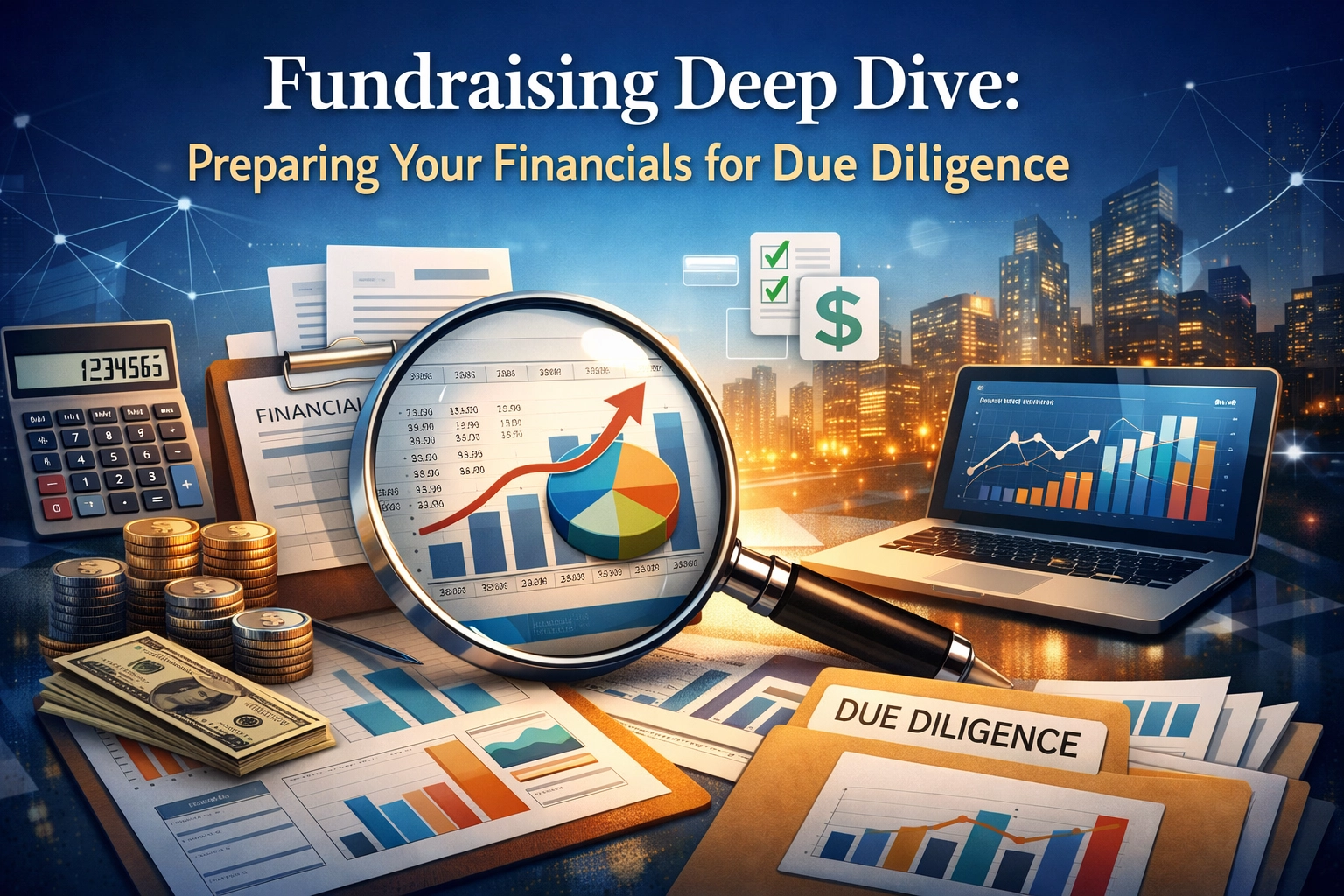
Fundraising Deep Dive: Preparing Your Financials for Due Diligence
Raising capital is often described as a marathon, but the due diligence (DD) phase is more akin to a high-stakes forensic audit. Once the initial excitement of the pitch deck fades, professional investors: whether VCs, private equity firms, or institutional partners: will pivot their focus to the "engine room" of your business: The Financials.
In this second installment of our series on building an investor-ready data room, we are moving beyond the high-level introductions to tackle the most scrutinized section of your virtual data room (VDR). Your financial documentation is the primary evidence for your valuation and the ultimate test of your operational integrity. If your numbers are disorganized, inconsistent, or opaque, the deal will stall. If they are meticulous, transparent, and robust, you build the trust necessary to close.
At MOHBILITY, we understand that this process can feel overwhelming. However, by treating your financial section as a narrative of your company’s health rather than just a pile of spreadsheets, you can turn a daunting requirement into a strategic advantage.
The Foundation: Historical Financial Statements
Investors look backward to predict the future. They need to see a clear, uninterrupted history of how you have managed capital. This isn't just about showing profit; it’s about showing financial discipline.
1. Profit and Loss (P&L) Statements
Your P&L (or Income Statement) is the heartbeat of your DD folder. You should provide at least three years of historical data (if applicable) and a Year-to-Date (YTD) report.
- What they look for: Revenue growth trends, gross margins, and operating leverage.
- The MOHBILITY Tip: Ensure your P&L is broken down by month, not just annually. Investors want to see seasonality and how you responded to specific market shifts or historical challenges.
2. Balance Sheets
While the P&L shows performance, the Balance Sheet shows stability. It lists your assets, liabilities, and equity at a specific point in time.
- What they look for: Liquidity ratios, debt levels, and how well you manage accounts receivable.
- Transparency is key: If you have significant outstanding debts or complex asset structures, disclose them early. Hidden liabilities discovered during DD are the number one cause of "deal fatigue."
3. Cash Flow Statements
Cash is the lifeblood of any growing enterprise. Investors are less interested in "paper profit" and more interested in actual cash movements.
- The Focus: Operating cash flow versus financing and investing activities. They need to see your burn rate and your runway: exactly how many months you can survive before you need the next infusion of capital.

The Roadmap: Financial Projections and Models
If historicals are the map of where you’ve been, your financial model is the GPS for where you are going. This is where most founders struggle, yet it is where business performance analysis becomes most critical.
Your projections should not be a "best-case scenario" fantasy. They must be a logical extension of your historical data, adjusted for the new capital you are raising.
Building a Robust Financial Model
- Revenue Assumptions: Do not just pick a number. Base your revenue on specific drivers: customer acquisition cost (CAC), churn rate, average contract value (ACV), or units sold.
- Scenario Analysis: A sophisticated data room includes "Base," "Best," and "Worst" case scenarios. This demonstrates to investors that you have a plan for market volatility.
- Use of Proceeds: Be explicit. If you are asking for $10M, your model should show exactly how that $10M translates into hiring, R&D, or market expansion, and how those investments drive the bottom line.

Suggested caption: A sophisticated financial model serves as the blueprint for your future growth and investor ROI.
Verification and Legitimacy: Audits and Tax Returns
Transparency is the currency of trust. You can claim your numbers are accurate, but third-party verification provides the "peace of mind" institutional investors require.
Audit Reports and Reviews
For mid-to-late-stage startups or established firms seeking M&A facilitation, audited financials are non-negotiable.
- Why it matters: An audit by a reputable accounting firm signals that your internal controls are robust and your reporting follows GAAP or IFRS standards.
- The MOHBILITY approach: Even if you aren't yet at the stage where a full audit is required, having a "CPA-reviewed" statement can significantly elevate your profile in the eyes of a sophisticated lead investor.
Tax Returns
Investors will request at least three years of federal and state tax returns.
- Consistency Check: They will cross-reference your tax filings with your internal P&L. Discrepancies here are a major red flag and suggest either poor bookkeeping or potential legal liabilities.
- 409A Valuations: If you have issued stock options, your data room must include your most recent 409A valuation reports to ensure compliance with tax laws regarding equity compensation.
The Cap Table: Ownership and Dilution
The Capitalization Table (Cap Table) is often tucked away in the financials section, but it is the first thing an investor looks at to see if the deal is "clean."
A messy Cap Table: filled with "handshake" equity deals, unrecorded convertible notes, or overly complex liquidation preferences: can kill a deal instantly. Your VDR should include:
- A clear list of all shareholders and their respective percentages.
- A summary of all debt instruments that could convert to equity.
- The current option pool and how much is unallocated.
Investors need to know exactly what percentage of the company they are buying and who they will be "sitting at the table" with after the deal closes. This is a core component of startup investment facilitation.

Common Financial Red Flags (And How to Solve Them)
As a seasoned partner in management consulting, MOHBILITY has seen where many talented founders trip up. To ensure a seamless due diligence process, proactively address these potential pitfalls:
- Inconsistent Revenue Recognition: Ensure you are recognizing revenue when it is earned, not just when the cash hits the bank. This is a common point of contention in SaaS and service-based industries.
- Commingled Expenses: If you are a founder-led business, ensure personal expenses are nowhere near your professional P&L. This is a matter of integrity and accountability.
- Outdated Records: If your "current" financials are more than 30 days old, you look unprepared. High-stakes environments require real-time data.
- Lack of Detail in COGS: Investors want to see exactly what it costs you to deliver your product. Hiding marketing spend inside Cost of Goods Sold (COGS) is a tactic that will be caught and questioned.
Positioning for Success with MOHBILITY
The financial section of your data room is more than a compliance requirement; it is your best opportunity to prove that you are a steward of capital. By presenting a meticulous, audit-ready financial package, you shift the conversation from "Can we trust these numbers?" to "How fast can we grow this business?"
At MOHBILITY, we specialize in helping executives navigate these complex landscapes. From business performance analysis to preparing for mergers and acquisitions, we act as your trusted partner to ensure your financials are not just accurate, but compelling.

Don’t leave your fundraising success to chance. If you are preparing for a capital raise or an exit, meticulous preparation is your only insurance policy.
Ready to build a world-class data room? Contact us today or book a consultation to ensure your financials are investor-ready. For more insights on scaling and global investment, explore our Insights library.
In our next installment, we will explore the Legal & Compliance section of the data room: ensuring your corporate house is in order before the lawyers arrive.