Agentic AI Consulting vs. Staff Augmentation: Which One Actually Ships in 90 Days?
“Ships in 90 days” sounds like a straightforward delivery promise. In practice, it can mean anything from a working demo to a production pilot with defined controls, a business owner, and measurable results.
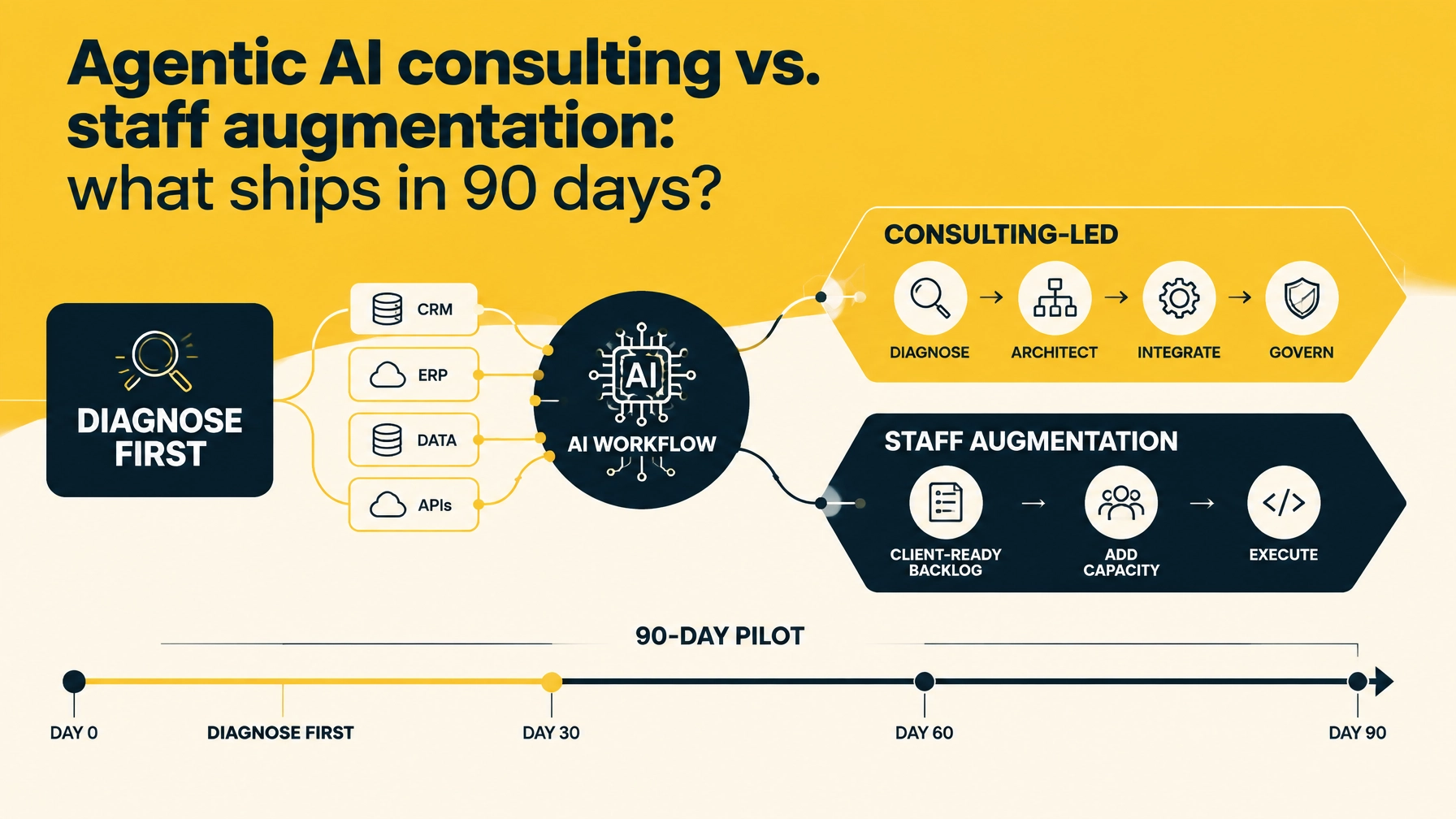
That distinction matters. Agentic AI consulting and staff augmentation can both contribute to delivery, but they solve different problems. Consulting can bring diagnosis, architecture, governance, and implementation leadership. Staff augmentation can add skilled capacity to a team that already knows what to build and how to operate it.
The right choice is not a matter of which model is universally better. It is a matter of diagnosing what is missing before you choose how to deliver.
First, define what “ships” means
For a 90-day initiative, a realistic target is usually a bounded production pilot, not enterprise-wide autonomy. The pilot should handle one specific workflow, work within explicit permissions, and include a human escalation path for actions that carry material risk.
Before you compare proposals, define the finish line. For example, “shipped” might mean:
- One business workflow is live with a limited user group.
- The agent can access only approved data and tools.
- Acceptance criteria and failure thresholds are documented.
- Human approval is required for specified high-impact actions.
- A named operating owner can monitor, escalate, and pause the system.
- Results are measured against a baseline, such as time to resolution or manual review hours.
Without this definition, a demo can be presented as a deployment, while a deployment may be judged against a business outcome no one agreed to measure.
The core difference: direction or capacity?
Agentic AI consulting is most useful when the organization still needs to determine what to build, how to control it, or how to move it into a real operating environment. A delivery-focused consulting engagement may include workflow diagnosis, system and data assessment, architecture, evaluation design, security coordination, integration, and implementation leadership.
Staff augmentation adds people to a team. It can increase engineering throughput, but the client typically remains responsible for priorities, architecture, acceptance, approvals, and production operations.
That division is not absolute. Some consulting engagements stop at recommendations; some augmented engineers are highly autonomous. The contract and delivery structure matter more than the label. Ask who owns the outcome, who makes decisions, and what must be accepted by day 90.

When consulting is more likely to get you to a pilot
A consulting-led approach is usually a better starting point when important questions remain unanswered:
- Which workflow should you automate first?
- Who owns the business process and its exceptions?
- What data and system permissions will the agent need?
- How will you evaluate quality, safety, and business impact?
- Who is responsible for security, privacy, legal review, and operational handoff?
These are not minor details to resolve after development. They determine scope, system design, risk controls, and whether the result can be used in a real process.
A capable consulting partner should not simply deliver strategy slides. The engagement should connect diagnosis to execution, with specific acceptance criteria and a defined path to a pilot. If the firm will not own the build, it should make the boundary between advisory work and client delivery explicit.
When staff augmentation can work well
Augmentation can be the more efficient choice when your internal team has already completed the foundational work. In practical terms, you have:
- A prioritized workflow with a clear business owner.
- A chosen architecture and established technical lead.
- Accessible APIs and approved data sources.
- An evaluation plan with measurable pass/fail criteria.
- Security and privacy review processes that can meet the schedule.
- A team ready to integrate, review, and operate the system.
In that setting, additional engineers can help deliver against a ready backlog. But if these prerequisites are absent, adding people may increase activity without resolving the actual bottleneck. You may have more hands and still lack decisions, access, evaluation, or release ownership.
A practical 90-day delivery path
A disciplined 90-day plan narrows the workflow before it expands the technology. The dates below are a planning framework, not a guarantee. Scope, data access, integrations, and approval speed all affect delivery.

Days 0–15: Diagnose. Select one workflow with a clear business owner and a measurable baseline. Map exceptions, data sources, system access, and existing approval steps. Define the agent’s permitted actions, prohibited actions, and escalation thresholds. Confirm who can approve the design and release.
Days 16–35: Build a thin slice. Create the smallest useful version against approved data. Establish evaluation cases, including expected behavior and known edge cases. Implement access controls, logging, and basic monitoring early, rather than treating them as a final checklist.
Days 36–60: Integrate and test. Connect to systems in a controlled environment. Test permissions, failure behavior, and the handoff to human reviewers. Run adversarial and operational tests before real users depend on the workflow.
Days 61–90: Pilot and govern. Release to a limited user group. Monitor quality, escalations, latency, cost, and the agreed business metric. Fix issues through controlled releases. Expand only if results meet the acceptance thresholds and the operating team is ready.
A pilot that reaches day 90 with a runbook, clear ownership, and evidence of performance is more valuable than a broad demo that cannot be safely maintained.
Put governance in the delivery plan
Agentic systems can take actions through tools and connected applications. That makes access, oversight, and traceability central delivery requirements, not optional enhancements.
Your project should define:
- Least-privilege access: Limit the agent’s permissions to the tools and data required for the workflow.
- Human approval: Specify which actions need review, who reviews them, and what happens if approval is delayed.
- Evaluation and monitoring: Test performance before release and monitor it during the pilot.
- Auditability: Record relevant decisions, tool calls, approvals, and outcomes in a way your organization can review.
- Rollback and pause procedures: Make it clear who can disable the workflow and how operations continue if it is paused.
The NIST Generative AI Profile offers a risk-management resource for organizations developing and using generative AI. The OWASP guidance on agentic AI threats and mitigations highlights security concerns such as tool misuse, identity compromise, and inadequate logging. Use these references to inform your controls, alongside your own regulatory, privacy, and security requirements.

A simple decision framework
Choose consulting-led delivery if the primary gap is clarity, design, governance, or cross-functional ownership. Choose staff augmentation if the use case and architecture are settled and your team needs more capacity to execute. Consider a hybrid if you need a short, accountable consulting-led phase to diagnose and build the first slice, followed by augmented engineers to extend a proven pattern.
For many organizations, the hybrid approach offers a sensible balance: diagnose before committing to a larger build, then scale capacity when the workflow, controls, and evaluation approach are understood. The key is to keep one accountable delivery owner. Splitting responsibility between an advisor, an engineering supplier, and internal stakeholders without a clear decision-maker can leave the pilot stuck between teams.
MOHBILITY’s technology advisory work is grounded in evaluating business needs before recommending a delivery path. You can explore our technology assessment and strategy work and technology portfolio for related context.
What to require from either partner
Before you sign, ask for a written plan that names:
- The workflow and business outcome targeted by day 90.
- The accountable delivery lead and client-side owner.
- Dependencies, including access, data, and approval dates.
- Acceptance tests and measurable success thresholds.
- Security, privacy, and human-approval requirements.
- The release, monitoring, rollback, and handoff plan.
If a consulting proposal ends at recommendations, it may not buy delivery. If an augmentation proposal prices people but leaves prioritization, architecture, acceptance, and operations entirely unresolved, it may add capacity without securing an outcome.
Diagnose the work first. Then choose the delivery model that matches the real constraint. That is how you improve the odds of shipping a useful, governed pilot in 90 days, and build a credible foundation for what comes next.