


Agentic AI in the Enterprise: Where to Deploy It, Where to Govern It, Where to Say No
Agentic AI has moved beyond conversation. It can interpret objectives, plan multi-step work, call enterprise tools, make recommendations, and execute actions across connected systems.
That capability creates significant opportunity. It also creates a leadership responsibility.
For CIOs, CTOs, COOs, and enterprise transformation leaders, the question is not whether your organization should deploy agentic AI. The more important questions are:
- Where can agentic AI produce measurable value?
- Which workflows require rigorous governance?
- Which activities should remain human-led?
- What controls must be in place before an agent can act?
- How do you build a practical roadmap instead of launching disconnected pilots?
A one-size-fits-all approach will not work. Your operating model, data environment, regulatory landscape, risk profile, and transformation priorities must determine where autonomy is appropriate.
The right starting point is a diagnose-first assessment of your workflows, not a technology demonstration.
The Enterprise Problem: Capability Is Advancing Faster Than Readiness
Agentic AI can accelerate service delivery, reduce manual effort, improve operational visibility, and help teams respond faster to complex requests. Yet many enterprises are approaching deployment from the wrong direction.
They begin with the technology. They select a model, connect a few tools, and then search for a business case.
That approach often creates:
- Pilots without clear ownership
- Uncontrolled access to sensitive data
- Duplicate experimentation across business units
- Weak measurement of business impact
- Unclear human approval requirements
- Security and compliance exposure
- Executive uncertainty about where to scale
Recent guidance from Deloitte, BCG, and Bain points toward a more disciplined path: define the business outcome, assess the workflow, establish controls, and then determine the appropriate level of autonomy.
Agentic AI should be managed as an operational capability, not treated as another software feature.

Where to Deploy Agentic AI First
Your first deployments should create visible value while maintaining manageable risk. The strongest candidates are usually internal, repeatable, measurable, and reversible.
1. Internal service operations
Internal service desks are often well suited to agentic AI because requests are structured and performance can be measured consistently.
An agent may:
- Classify and route employee requests
- Retrieve approved policy information
- Initiate standard access or equipment workflows
- Summarize incidents for service teams
- Escalate exceptions to the appropriate owner
- Track resolution status across systems
The agent should not receive unrestricted administrative access. It should operate within tightly defined permissions and escalate requests involving unusual access, sensitive personnel matters, or policy exceptions.
2. Document-intensive workflows
Legal operations, procurement, finance, compliance, and human resources often depend on high volumes of documents and repetitive review.
Agentic AI can help you:
- Extract key terms and obligations
- Compare documents against approved standards
- Identify missing information
- Route documents to the correct reviewer
- Prepare summaries for human approval
- Flag potential compliance issues
This is an attractive deployment area because the agent can support decisions without necessarily making irreversible decisions itself. Every output should remain traceable to its source material, with clear confidence indicators and review requirements.
3. IT operations and software delivery
IT operations and software development are among the most practical areas for agentic AI adoption. Properly governed agents can monitor environments, investigate alerts, prepare remediation steps, and support development teams.
Potential applications include:
- Incident triage and prioritization
- Log analysis and root-cause investigation
- Test generation and code review support
- Infrastructure monitoring
- Deployment preparation
- Vulnerability identification
- Knowledge base maintenance
However, deployment authority should be graduated. An agent may recommend a change before it is permitted to implement one. Production changes, identity modifications, and security policy updates should require explicit approval or multiple control layers.
Your broader technology assessment and strategy development process should identify whether your current infrastructure can support this level of automation securely.
4. Supply chain and operational coordination
Agents can improve coordination across inventory, logistics, procurement, and fulfillment workflows. They can monitor events, identify exceptions, compare alternatives, and notify responsible teams.
This is especially useful when delays result from fragmented information rather than difficult decisions.
Start with recommendation and coordination use cases. Expand autonomy only when:
- Data quality is reliable
- Exceptions are clearly defined
- Financial and operational thresholds are documented
- Human escalation is immediate
- Actions are reversible
- Performance can be monitored continuously
Where to Govern Agentic AI Closely
Some workflows can create substantial value but also carry material business, legal, financial, or reputational risk. These should not be rejected automatically. They should be governed according to their potential impact.

Customer-facing decisions
Customer service agents can resolve routine questions, initiate standard processes, and provide personalized assistance. But the risk rises when an agent can issue refunds, change contractual terms, interpret policy, or communicate commitments on behalf of your organization.
Use governance controls such as:
- Approved response and action libraries
- Transaction and discount thresholds
- Escalation for complaints or legal matters
- Human review for strategic accounts
- Full conversation and action logging
- Restrictions on unsupported claims
The objective is not to eliminate automation. It is to make the agent’s authority proportional to the consequence of its actions.
Financial analysis and transactions
Agentic AI can support forecasting, reconciliation, scenario analysis, and investment research. It requires significantly stronger governance when it can approve credit, alter pricing, initiate payments, execute trades, or make underwriting decisions.
You should establish:
- Segregation of duties
- Predefined approval thresholds
- Independent validation of key outputs
- Complete audit trails
- Exception monitoring
- Human sign-off for material decisions
In these environments, an agent should not become the only system of judgment.
Access to sensitive enterprise data
An agent with broad access to identity systems, customer records, financial data, intellectual property, or security controls represents a concentrated risk.
Apply the principle of least privilege:
- Give the agent only the access required for the approved workflow
- Restrict data by role, purpose, geography, and sensitivity
- Prevent agents from expanding their own permissions
- Separate retrieval from execution authority
- Monitor unusual access patterns
- Revoke access immediately when the agent is retired or compromised
Governance must include the full agent lifecycle: design, testing, approval, deployment, monitoring, version changes, and retirement.
Where to Say No
Disciplined leadership includes knowing when not to automate.

You should generally reject, restrict, or redesign an agentic use case when it has one or more of the following characteristics:
- The action is irreversible or difficult to reverse
- The workflow affects physical safety
- The decision creates legal obligations
- The agent can move significant funds without approval
- The outcome depends on sensitive personal characteristics
- The data foundation is incomplete or unreliable
- Accountability cannot be assigned to a named business owner
- The agent cannot provide an adequate audit trail
- A human cannot intervene quickly
- The expected value is too small to justify the control burden
Safety-critical industrial control, autonomous changes to legal records, unrestricted security administration, and unsupervised high-value financial activity require exceptional evidence before deployment.
In some cases, the right answer is recommendation-only operation. In others, the correct answer is no.
Saying no is not resistance to innovation. It is a demonstration of accountability, integrity, and operational maturity.
The Guardrails Every Enterprise Agent Should Have
A credible agentic AI operating model includes technical and organizational controls. At a minimum, you should define:
Business ownership: Every agent needs a named executive sponsor and operational owner.
Risk classification: Classify the agent according to data sensitivity, autonomy, business impact, and regulatory exposure.
Permission boundaries: Limit tool access, data access, transaction authority, and system changes.
Human checkpoints: Specify which actions require review, approval, escalation, or dual control.
Observability: Log inputs, outputs, tool calls, decisions, approvals, errors, and system changes.
Testing and validation: Test for accuracy, security, bias, prompt injection, failure conditions, and unexpected behavior.
Version control: Track changes to prompts, models, tools, data sources, policies, and workflows.
Kill switches: Maintain a tested process to suspend the agent and revoke its access quickly.
Performance metrics: Measure business outcomes, quality, exception rates, cost, cycle time, and risk events.
This governance layer should be embedded before production deployment. Retrofitting control after an incident is expensive, disruptive, and damaging to trust.
A Practical 90-Day Path Forward
You do not need to automate the entire enterprise to begin. You need a prioritized, evidence-based sequence.

Days 1 to 30: Diagnose
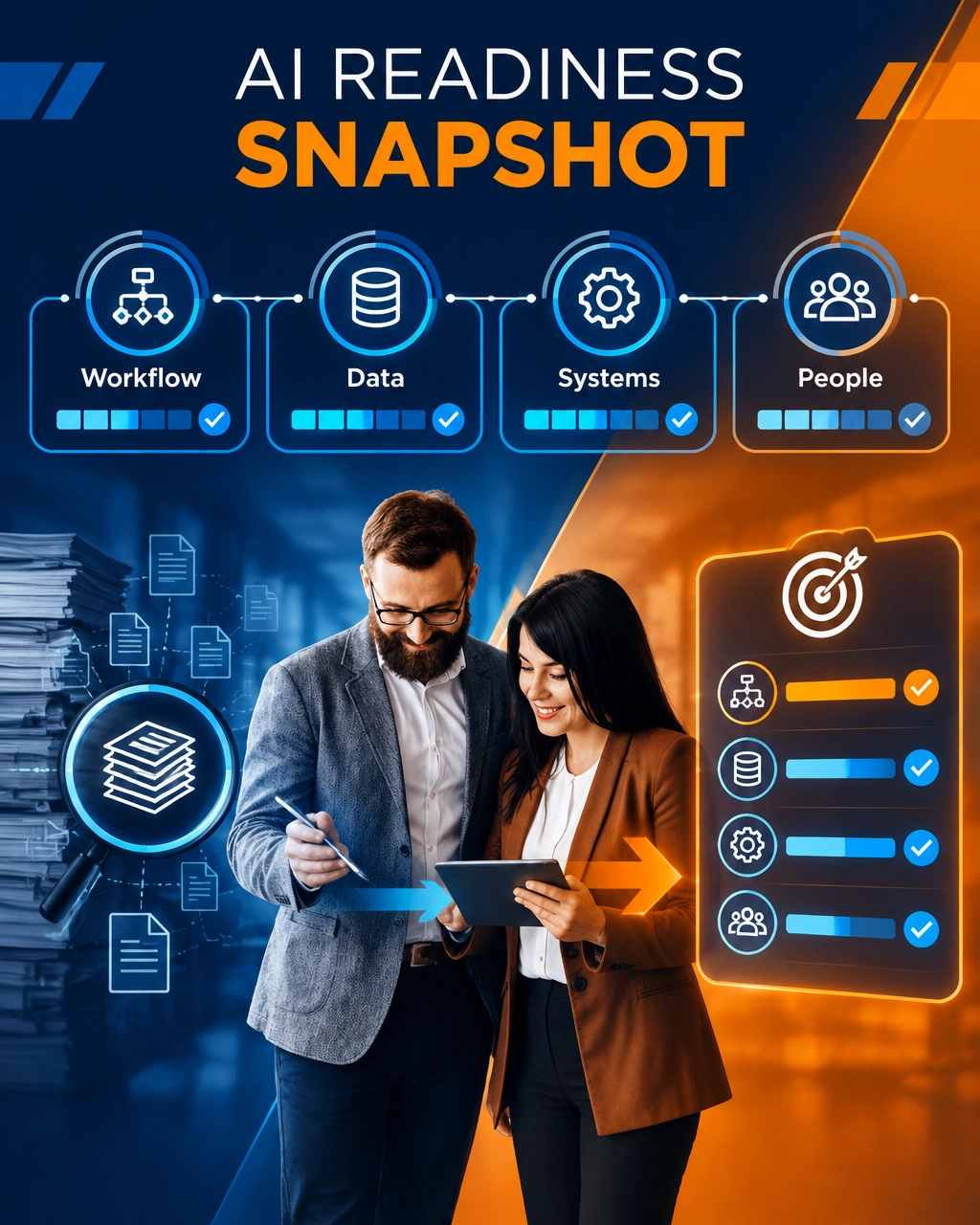
Map the workflows that consume significant time, create recurring delays, generate high error rates, or depend on fragmented information.
Assess:
- Business value
- Process maturity
- Data readiness
- System connectivity
- Risk and regulatory exposure
- Existing human decision points
- Reversibility of actions
Days 31 to 60: Prioritize
Rank opportunities by expected impact and implementation complexity. Separate use cases into three categories:
- Deploy: High-value, repeatable, measurable, and controllable
- Govern: Valuable but requiring strong approval and monitoring
- Say no or redesign: Excessive risk, weak data, unclear ownership, or limited economic value
Define the business case for each priority workflow. Estimate potential impact across cost, cycle time, service quality, revenue, resilience, and risk reduction.
Days 61 to 90: Activate
Select one or two priority workflows for controlled implementation. Establish the operating model, governance requirements, baseline metrics, and escalation paths.
Your first 90-day plan should include:
- A defined business owner
- A documented workflow and agent scope
- Data and system access requirements
- Approval and escalation rules
- Security and compliance review
- Pilot success criteria
- Monitoring and reporting cadence
- Scale, redesign, or stop criteria
This is the purpose of a structured Enterprise AI Opportunity Audit. The engagement identifies high-value workflows, estimates potential impact, prioritizes opportunities, and produces a practical 90-day action plan. You leave with a clear view of where agentic AI can deliver measurable business value first, what should be governed more tightly, and how to move into execution with a practical 90-day roadmap.
Move From AI Ambition to Controlled Enterprise Value
Agentic AI can transform enterprise operations, but only when deployment is connected to strategy, governance, data, and measurable outcomes.
Your organization does not need more disconnected experiments. You need clarity about where autonomy creates value, where oversight protects the enterprise, and where restraint is the most responsible decision.
A trusted partner can help you move from uncertainty to a prioritized roadmap grounded in transparency, accountability, and business performance. Explore Business Performance Analysis to strengthen your data-driven decision process, review the Belmont Cloud case study for an example of technology, security, scalability, and automation working together, or speak with an advisor about your Enterprise AI Opportunity Audit.
Diagnose first. Govern deliberately. Deploy where the value is real. Say no when the risk is not acceptable.