

Les investisseurs sont divisés en 2026 : voici ce qu'il faut pour être du bon côté de la scission
For founders preparing to raise capital in 2026, the market can appear contradictory.
Venture funding remains available. Major companies continue to secure outsized rounds. New funds are still entering the market. Yet many credible startups are discovering that fundraising is taking longer, investor scrutiny is sharper, and outcomes are less predictable than anticipated.
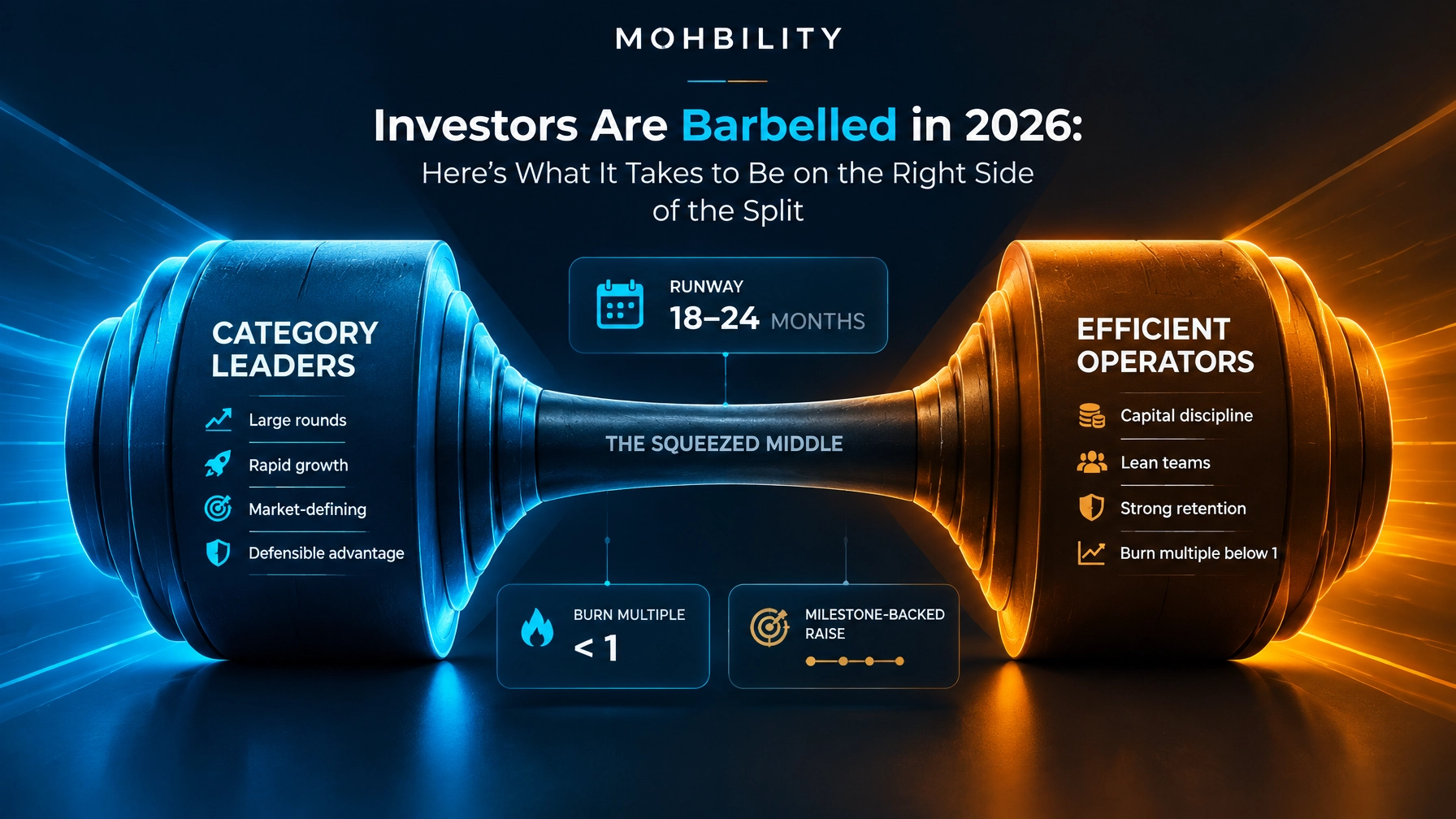
The reason is structural. The market has become barbelled.
Capital is concentrating at two ends:
- A small group of category leaders is attracting very large rounds.
- Efficient early-stage companies are securing focused, disciplined financings.
- Companies in the middle are facing greater scrutiny and fewer straightforward paths forward.
This environment does not mean your company cannot raise capital. It means your company must be positioned with clarity and precision. Investors want to understand whether you are building toward category leadership, operating with exceptional capital efficiency, or combining both in a credible, evidence-based way.
If you have an active or upcoming raise within the next three to nine months, your preparation should begin with diagnosis. Before you refine your pitch deck or begin investor outreach, you need an honest assessment of your market position, operating metrics, runway, risks, and investment narrative.
The 2026 fundraising market is not closed. It is concentrated.
Recent venture market analysis points to a widening gap between mega-rounds and smaller early-stage financings. The Q1 2026 PitchBook-NVCA Venture Monitor reflects the continuing concentration of capital in later-stage and high-conviction opportunities.
Other market reviews point to the same conclusion. A relatively small number of companies are capturing a disproportionate share of available venture capital, while many others are being asked to deliver more progress with fewer resources.
That is why you may hear two seemingly conflicting messages:
- Venture capital deployment is strong.
- Fundraising is extremely difficult.
Both can be true at the same time. Capital is available, but investors are allocating it with greater selectivity and higher expectations. They are looking for companies that present a compelling combination of:
- Large and defensible market opportunity
- Clear evidence of product-market fit
- Strong growth relative to cash consumption
- A credible path to category leadership
- Sufficient runway to withstand a longer fundraising cycle
- Reliable financial and operating data
The old approach of raising enough money to discover the business model is becoming increasingly difficult to defend. Investors want confidence that you understand the business model, the risks, and the precise milestones the next round of capital will unlock.

The two sides of the barbell
The barbell is not simply a distinction between large companies and small companies. It is a distinction between investor conviction and investor hesitation.
1. Category leaders
At one end are companies that investors believe could define or dominate a market. These businesses often demonstrate several of the following characteristics:
- Rapid and sustained revenue growth
- Strong customer adoption in a large market
- Meaningful proprietary technology or data
- A clear competitive advantage
- A credible path to market leadership
- Strong demand from strategic or institutional investors
These companies can raise substantial rounds because investors are competing for access to an opportunity they believe could become category-defining.
You do not need to be a household name to build a category leadership case. You do, however, need to explain precisely why your company can win, what makes the market structurally attractive, and why competitors will struggle to replicate your advantage.
A broad market alone is not enough. A compelling category leadership thesis answers questions such as:
- What specific market are you defining or reshaping?
- Why is the timing favorable now?
- What customer problem is urgent enough to drive adoption?
- What evidence shows that your solution is becoming the preferred option?
- What advantage strengthens as you scale?
2. Efficient companies
At the other end are companies that may not yet dominate a category but are demonstrating disciplined execution.
These businesses often show:
- Focused customer acquisition
- Lean teams
- Clear pricing and monetization
- Strong retention or repeat usage
- A controlled cost structure
- A credible path to profitability or self-sustaining growth
For these companies, efficiency is not a defensive posture. It is a credible investment proposition.
An efficient company has greater strategic flexibility. It can extend runway, negotiate from a stronger position, and avoid poor decisions driven by fundraising pressure.
This matters especially at the seed and Series A stages. Research and commentary on the 2026 market suggest that the traditional middle market, including the classic Series A, is under considerable pressure. NextWave Partners describes the current environment as one in which founders must prove more while raising less.
The squeezed middle is where preparation matters most
The most exposed companies are not necessarily weak businesses. They are businesses that do not yet present as category leaders and are not yet efficient enough to justify a lower-risk investment case.
This creates a difficult question for founders:
What should investors believe about your company today?
If your answer is only that the market is large and the product is promising, you may not yet be ready for a competitive raise. Investors need a more specific explanation of how the business will create value, how capital will be deployed, and why the risk-reward profile is attractive.
You should be able to demonstrate one or both of these positions:
- Leadership position: You are building a differentiated company with the potential to control an important market.
- Efficiency position: You are growing with discipline and can reach meaningful milestones without depending on constant fundraising.
Positioning your company as both a category leader and an efficient operator is possible. It requires evidence, not aspiration.
The three numbers investors will examine closely
A strong fundraising narrative must be reinforced by operating discipline. Three measures deserve particular attention.
1. Runway of 18 to 24 months
A 12-month runway may not provide enough time to raise your next round, achieve new milestones, and absorb unexpected delays.
Investor processes can take longer than expected. Enterprise sales cycles can shift. Hiring plans can change. A product launch may require additional iteration. Your financial model must reflect the reality that progress rarely unfolds in a straight line.
A prudent plan targets 18 to 24 months of post-raise runway. This does not mean raising an unnecessarily large round. It means building a realistic plan around:
- Conservative revenue assumptions
- Hiring tied to measurable milestones
- Downside scenarios
- Delayed fundraising timelines
- Sufficient cash reserves for operational surprises
Your runway should be clearly reflected in your board materials, financial model, and investor narrative. If those three sources present different assumptions, investor confidence can erode quickly.
2. Burn multiple below 1
Burn multiple measures how much net cash you burn to generate a unit of net new recurring revenue. A simplified formula is:
Burn multiple = net burn divided by net new ARR
A burn multiple below 1 indicates that you are generating more new recurring revenue than the cash you are consuming to produce it. That is a powerful signal of operating efficiency.
The right target depends on your stage, business model, and growth rate. A young company may reasonably invest ahead of revenue. However, the trajectory of the metric matters. Investors want to see that your business is becoming more efficient as it scales.
Review your burn multiple alongside:
- Customer acquisition cost
- Payback period
- Gross margin
- Net revenue retention
- Sales cycle length
- Expansion revenue
- Headcount productivity
Do not present one favorable metric in isolation. A robust investor case connects the numbers and explains the operating choices behind them.
3. Milestones that change your financing position
Your next round should not be based on a vague promise of growth. It should be tied to milestones that materially strengthen your financing position.
Examples include:
- Reaching a defined ARR threshold
- Securing anchor enterprise customers
- Improving retention to a target level
- Completing a critical product integration
- Demonstrating repeatable customer acquisition
- Entering a defensible geographic or vertical market
- Reaching break-even in a core business line
Each milestone should have an owner, a timeline, a financial requirement, and a measurable outcome.

Diagnose your position before you launch the raise
A fundraising process often falters before the first investor meeting because the company has not diagnosed its readiness accurately.
Before you begin outreach, assess:
- Your current position in the market
- The strength of your category leadership argument
- The quality and consistency of your financial data
- Your runway under base and downside scenarios
- Your burn multiple trend
- Your customer concentration risk
- Your product and technology defensibility
- Your regulatory and operational exposure
- The milestones the next round will fund
- The investors most aligned with your stage and strategy
This is not a generic checklist. Your diagnostic should reflect your business model, sector, geography, stage, and fundraising objectives.
For example, a software company preparing for a Series A may need to focus on retention, sales efficiency, and repeatable distribution. A deep technology company may need stronger evidence around technical validation, deployment timelines, and strategic partnerships. A cross-border business may need additional work around regulatory exposure, international operations, and market-entry assumptions.
There is no one-size-fits-all route to capital readiness. Tailored preparation is what gives you credibility in a selective market.
A stronger fundraising process starts before the pitch deck
Once you understand your position, you can build a more credible raise around the facts.
Your preparation should include:
- A clear investment thesis
- A concise explanation of the customer problem
- Evidence of demand and retention
- A defensible market map
- A detailed use-of-funds plan
- An 18 to 24-month operating model
- A data room with consistent documentation
- A realistic investor target list
- A plan for managing diligence questions
- A communication process for current stakeholders
Investors do not expect certainty. They do expect transparency, accountability, and command of the details.
If a metric is weak, explain why. If a risk is material, show how you are managing it. If a forecast depends on an assumption, make that assumption visible.
Integrity strengthens the fundraising process. Overstating traction may generate short-term interest, but it can damage trust during diligence.
The right side of the split is built, not claimed
The 2026 barbell market rewards companies that make their position easy for investors to understand.
You do not have to compete with the largest venture-backed companies for the same type of capital. You do need to demonstrate why your company belongs on the side of the market that investors are prepared to back.
That means choosing your strongest case:
- Build a credible path to category leadership.
- Operate with measurable and improving capital efficiency.
- Maintain 18 to 24 months of runway after the raise.
- Target a burn multiple below 1 where your business model allows it.
- Tie capital to milestones that materially improve your next financing position.
Our Investment Readiness Diagnostic helps founders identify the gaps between their current position and investor expectations. From there, the Founder Readiness Sprint provides a focused plan to strengthen the financial model, operating narrative, diligence materials, and fundraising strategy.
The process begins with diagnosis, not presentation.
If your raise is three to nine months away, now is the time to examine the evidence, clarify your position, and make the necessary changes. Capital is still available. Prepared companies are in a stronger position to secure it.
Explore startup investment facilitation or review the business performance analysis guide to strengthen the foundation behind your next raise.
Your next round should reflect the quality of the business you are building. Prepare accordingly.