
The 30-Minute Discovery That Saves Service Business Owners 15 Hours a Week
You do not need another technology presentation.
You need clarity on where your business is losing time, which workflows are ready for improvement, and what can realistically be changed without disrupting customer service.
For many owner-led service businesses, the most valuable AI opportunity is not a complex enterprise platform. It is a targeted improvement to the repetitive work that consumes leadership capacity every week:
- Answering routine calls and inquiries
- Scheduling jobs and coordinating dispatch
- Preparing estimates and quotes
- Following up with prospects
- Sending customer updates
- Producing marketing content
- Managing internal administrative work
When these tasks remain fragmented, the cost is substantial. You lose hours, response speed declines, and strategic decisions are repeatedly pushed aside.
The solution begins with diagnosis.
Why AI adoption feels overwhelming for local service businesses
AI adoption can appear complex, expensive, and disconnected from the realities of a local service operation. You may hear about advanced models, autonomous agents, and large-scale transformation programs while your immediate concerns are more practical:
- How quickly can you respond to a new inquiry?
- How many leads require manual follow-up?
- How much time does your team spend moving information between systems?
- How often are appointments rescheduled because communication breaks down?
- Which administrative tasks still depend on the owner?
This gap between technology discussions and operational reality prevents many businesses from moving forward.
Research from the UK Department for Science, Innovation and Technology found that the most common barriers to AI adoption were a lack of identified use cases and limited AI skills or expertise. Among businesses planning to adopt AI, only 34% felt ready to implement it. The same research found that 75% of current AI users reported improved workforce productivity, while 57% reported developing improved processes or operations.
The message is clear: AI creates value when it is connected to a defined operational problem.
That is the purpose of the AI Readiness Snapshot.
The AI Readiness Snapshot: a focused 30-minute discovery
The AI Readiness Snapshot is a structured discovery session for local service businesses and leadership teams with approximately 5 to 100 employees.
It is designed to give you a practical answer to three questions:
- Where is your business losing time today?
- Which workflows are suitable for AI or automation?
- What should you do first over the next 90 days?
This is not a generic technology consultation. It is not a product demonstration. It is not a one-size-fits-all checklist.
It is a concise, tailored diagnostic that connects your operational reality to a prioritized AI adoption path.

What happens during the 30-minute discovery
The session is divided into three practical stages. Each stage is designed to produce a clear decision, not simply more information.
1. Map repetitive work, 10 minutes
The first stage focuses on workflow friction.
You identify the tasks that happen repeatedly, require manual coordination, or create delays across your business. These often include:
- Calls and customer inquiries
- Appointment booking and rescheduling
- Dispatch coordination
- Quote preparation
- Lead qualification
- Follow-up reminders
- Review requests
- Customer status updates
- Recurring administrative reporting
The objective is not to automate everything. It is to identify the few activities where a practical intervention could release meaningful capacity.
If your team spends ten hours each week answering questions that follow predictable patterns, that is a different opportunity from a business that loses ten hours to fragmented scheduling and dispatch systems.
The distinction matters.
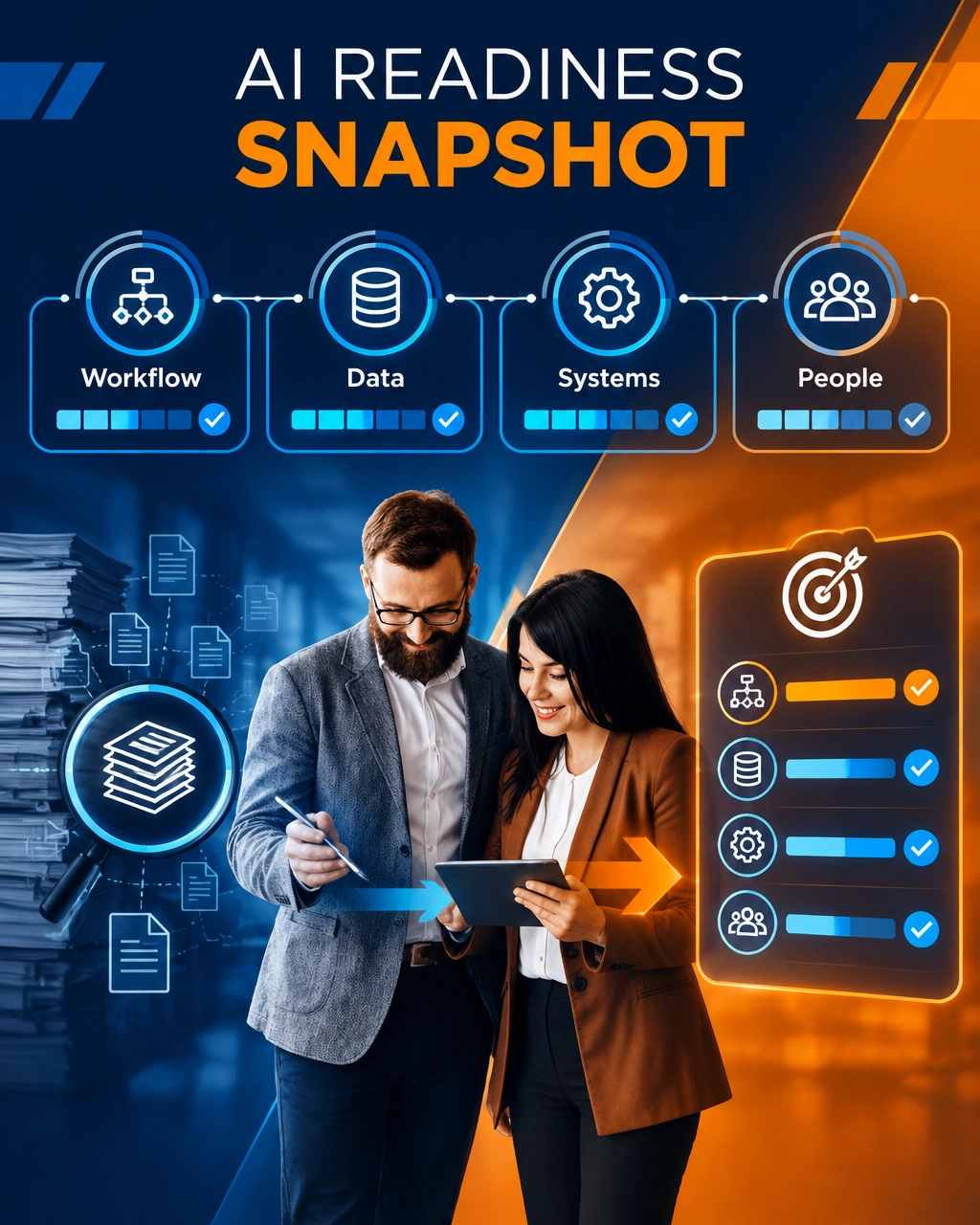
2. Score readiness, 10 minutes
The second stage evaluates whether your business is prepared to adopt and sustain AI-enabled workflows.
The scorecard should examine five dimensions:
- Workflow friction: Where manual work, delays, and bottlenecks affect performance
- Data and documentation: Whether essential customer, job, and process information is organized and accessible
- Tools and infrastructure: The quality of your existing CRM, calendar, phone, booking, website, and operational systems
- Team readiness: Your employees’ skills, confidence, and capacity to adopt new processes
- Governance and risk: Data security, customer privacy, human oversight, and accountability requirements
Each dimension should be assessed against your actual business conditions. A company with strong systems but inconsistent process documentation has a different starting point from a company with a capable team and disconnected tools.
Your score is not a judgment. It is a decision aid.
It should reveal:
- What is already working
- Where implementation risk is concentrated
- Which opportunities can be addressed quickly
- Which foundational issues should be resolved first
- Whether your business is ready for a pilot, a broader architecture, or additional preparation
3. Prioritize three AI workflows, 10 minutes
The final stage converts diagnosis into action.
You should leave with three prioritized workflows, each connected to:
- The operational problem it addresses
- The expected benefit
- The data or systems required
- The level of human oversight needed
- The likely implementation complexity
- The metric that will define success
For example, your first three opportunities may include:
- An AI-supported phone and inquiry process to reduce missed opportunities
- Automated quote follow-up to improve response consistency
- A marketing content workflow that reduces owner involvement in routine production
The 30-minute discovery does not promise that every business will immediately save 15 hours per week. It identifies the workflows most likely to create that level of capacity once properly implemented and measured.
That distinction protects your investment and keeps expectations accountable.

What the scorecard output should reveal
A useful scorecard should be concise enough for an owner to understand quickly and rigorous enough to support a real decision.
Your output should include:
A readiness position
You should know whether your organization is:
- Unclear: The business has not yet identified a compelling use case or lacks reliable process visibility
- Developing: Opportunities exist, but tools, data, documentation, or team readiness require attention
- Ready to pilot: A focused workflow can be tested with defined ownership and measurable outcomes
- Ready to scale: The business has enough process discipline, system connectivity, and governance to expand adoption
A ranked opportunity list
The scorecard should distinguish high-value opportunities from attractive distractions.
Each opportunity should be ranked according to:
- Potential time savings
- Customer or revenue impact
- Implementation effort
- Data sensitivity
- Integration requirements
- Confidence in measurable results
A 90-day roadmap
Your plan should be sequenced rather than overloaded.
A practical roadmap may include:
- Days 1 to 30: Validate the diagnosis, document the selected process, and confirm data and system requirements
- Days 31 to 60: Configure or connect the selected workflow, train responsible team members, and begin measurement
- Days 61 to 90: Review performance, correct weaknesses, formalize governance, and decide whether to scale
This approach prevents a common mistake: investing in tools before defining the operating model around them.
From Diagnose to Govern and Scale
The AI Readiness Snapshot is the first step in a broader transformation pathway:
- Diagnose: Understand workflow friction, readiness, and risk
- Architect: Design the right operating model, systems, and use-case sequence
- Connect: Integrate tools, data, and communication channels
- Execute: Launch pilots, train your team, and measure performance
- Govern and Scale: Establish accountability, improve controls, and expand what works
This sequence is particularly important for local service businesses. Your reputation depends on customer trust, timely communication, and consistent delivery. AI should strengthen those qualities, not weaken them.
Human oversight remains essential. The DSIT research found that 84% of businesses using AI reported at least some human checking of AI outputs, with 67% reporting significant input or checking. Responsible adoption requires integrity, transparency, and accountability at every stage.

When the SMB snapshot is the right starting point
The AI Readiness Snapshot is designed for owner-led businesses that need a focused, practical starting point.
It is especially relevant if:
- Your leadership team is spending too much time on repetitive administration
- Your business has tested AI tools without a clear operating plan
- Your systems do not communicate effectively
- You are unsure which use case should come first
- You want measurable results without committing to a large transformation program
- You need a credible basis for investment decisions
For larger organizations or more complex operating environments, the next step may be an Enterprise AI Opportunity Audit. That engagement provides a more comprehensive assessment across departments, systems, data environments, governance requirements, and transformation priorities, making it the right fit when you need greater scope, deeper analysis, and a more robust approach to enterprise complexity.
The right choice depends on your scale, complexity, and decision horizon.
Your next step is diagnosis
The cost of inaction is not limited to missed technology opportunities. It includes continued owner dependency, slower customer response, inconsistent follow-up, and valuable leadership time spent on work that should be more structured.
A 30-minute conversation will not solve every operational challenge.
It can reveal where to begin.
Request your AI Readiness Snapshot and receive a practical view of your readiness, your highest-value opportunities, and the first 90 days of execution.
Start with evidence. Prioritize what matters. Build only what your business is ready to sustain.
For broader operational insight, explore Business Performance Analysis and learn how data-driven analysis can help you identify inefficiencies, strengthen performance, and build a tailored growth roadmap. You can also review the principles behind technology assessment and strategy development before making your next investment decision.