

Circular Economy Strategies: Optimizing Global Supply Chains with AI
The traditional "take-make-waste" linear model is no longer just an environmental liability; it is a profound business risk. In a global landscape defined by resource scarcity, volatile material costs, and aggressive regulatory shifts like the EU’s Ecodesign for Sustainable Products Regulation, the ability to close the loop is a competitive necessity. However, transitioning to a circular economy is a task of immense complexity. It requires the orchestration of reverse flows, the tracking of microscopic material data, and the synchronization of disparate global stakeholders.
To navigate this "complex" and "daunting" transition, you need more than just a sustainability mandate. You need a technological "nervous system." Artificial Intelligence (AI) has emerged as the definitive tool for business process optimization within the circular framework, transforming fragmented data into a seamless, high-performance value chain.
The Crisis of Complexity: Why Linear Supply Chains Fail
Traditional supply chains are designed for one-way speed and efficiency. They are structurally ill-equipped to handle the "return" leg of the journey. When products reach their end-of-life, the lack of data regarding material composition, usage history, and condition often leads to "downgrading": where high-value materials are processed into low-value waste.
For the modern executive, the challenge is two-fold:
- Data Fragmentation: Information about a product’s lifecycle is often siloed, making it impossible to predict when materials will return to the loop.
- Operational Friction: Reverse logistics: collecting, sorting, and refurbishing: is historically labor-intensive and cost-prohibitive.
Without a robust digital strategy, circularity remains a noble goal rather than a profitable reality. This is where AI-driven international business management consulting becomes your most vital asset, steering your organization toward a future where waste is structurally eliminated.
AI: The "Nervous System" of Circularity
AI does not just monitor the supply chain; it optimizes it in real-time. By acting as an intelligent layer across your operations, AI enables the transparency and predictability required to make circularity profitable. It allows you to maximize resource productivity while minimizing the risks associated with global material volatility.
1. Designing for the Infinite Loop
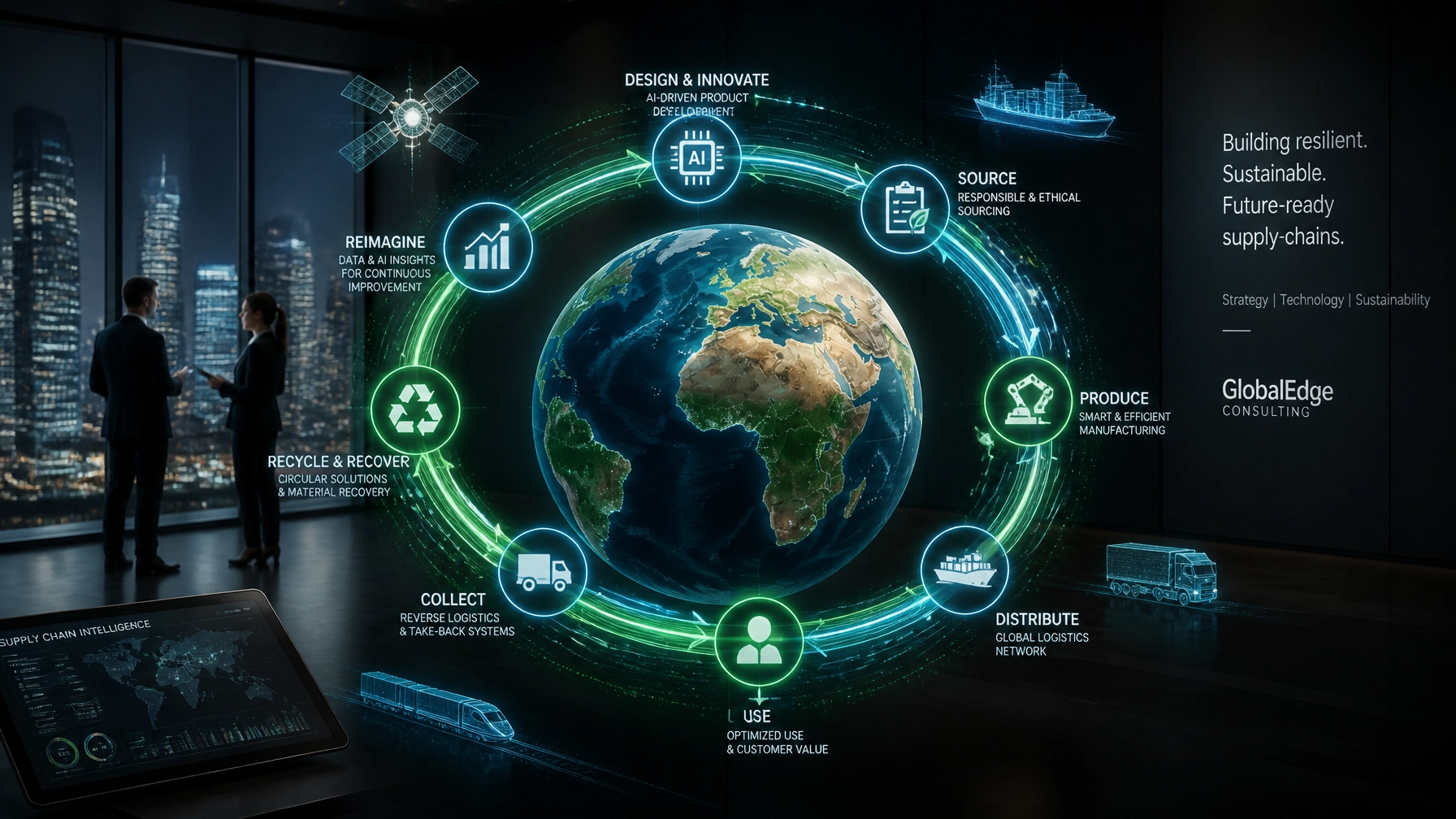
The transition begins at the drawing board. Using generative AI for "inverse design," your R&D teams can simulate thousands of material combinations to identify molecular structures that are both durable and easily recyclable.
This proactive approach ensures that products are engineered for disassembly from day one. By integrating AI into your technology assessment and strategy development, you can reduce lifecycle emissions and ensure your products remain high-value assets even at their end-of-life.
2. The Digital Product Passport (DPP): Trust at Scale
By 2026, the Digital Product Passport (DPP) will be a standard requirement for global trade. A DPP is a comprehensive digital record: often underpinned by blockchain and AI: that tracks every chemical and material within a product.

AI-enabled DPPs provide the "peace of mind" that regulators and customers now demand. These passports automate the collection of data from thousands of suppliers, ensuring cyber security and data privacy compliance while providing a transparent audit trail for secondary material markets. For your business, this translates to seamless market access and enhanced brand integrity.
3. Precision Sorting and Autonomous Reverse Logistics
One of the most significant barriers to circularity is the cost of recovery. AI-powered computer vision is revolutionizing this space. High-speed sorting robots can now identify and categorize waste with over 95% purity, effectively doubling the efficiency of traditional recycling facilities.
Furthermore, AI-driven predictive analytics optimize the routing of collection vehicles based on live sensor data. This reduces transport emissions by up to 35% and cuts operational costs by nearly a third. By implementing these agile implementation consulting strategies, you transform a cost center (waste) into a profit center (secondary raw materials).

Business Process Optimization for the Circular Era
Circular economy strategies require a fundamental reimagining of how your business operates. It is no longer enough to optimize for the next quarter; you must optimize for the next decade. AI-driven business process optimization allows you to sense demand shifts in real-time, preventing overproduction and ensuring that your inventory matches both primary and secondary material availability.

At its core, this is about Strategic Corporate Transformation. We help you move from a predictive model: where you guess what the market needs: to an agentic model, where your supply chain autonomously recommends actions to recover value and mitigate disruptions. This level of sophistication is what defines global excellence in the mid-2020s.
Crafting Your Global Trade Investment Strategy
Investing in circularity is not just a "green" move; it is a Global trade investment strategy that yields higher revenue growth. Data shows that companies heavily invested in AI-driven supply chain operations see significantly higher revenue uplift than their peers.
The future of trade is increasingly regionalized and data-rich. We are seeing the rise of "Regional Circular Hubs": localized clusters where repair, remanufacturing, and recycling happen in close proximity to the consumer. AI is the tool that coordinates these decentralized networks, ensuring that material flows are optimized across borders.

To succeed in this environment, your investment strategy must prioritize:
- Infrastructure Technology Assessment: Evaluating the readiness of your current tech stack to handle reverse material flows.
- International Investment Advisory: Identifying high-growth opportunities in secondary material markets and circular technology startups.
- Risk Assessment: Quantifying the Scope 3 emissions benefits of circular models to ensure long-term regulatory compliance.
Your Partner in Global Transformation
The transition to a circular economy is a journey into uncharted territory. It requires a partner who combines meticulous data expertise with a comprehensive understanding of global trade dynamics.
We don't believe in "one-size-fits-all" consulting. We provide tailored solutions that empower your leadership to make decisive, data-driven moves. Whether you are a multi-national looking to maximize returns through digital transformation or a startup seeking Global Investment Facilitation, we are here to steer you through the complexities of the modern regulatory and technological landscape.
Unlock the full potential of your supply chain. Let us help you transform your global operations into a resilient, profitable, and circular powerhouse. The future of global business is not just digital; it is circular, and the time to maximize your advantage is now.